Toddler Books: A Parent's Guide to the Right Books at Every Stage
The best toddler books from birth to 5, including board books, picture books, and chapter book bridges organized by how your child actually reads at each stage.
Minari Editor
There are over 250,000 children's books in print right now. Your toddler needs about ten.
Not ten forever — ten right now. Because the books that work at eighteen months are wrong at three. The books that captivate a three-year-old bore a five-year-old. And the books that every list tells you to buy? Half of them are for the wrong stage.
This is what most book lists miss: toddler books aren't a category. They're a progression. What your child needs from a book changes every few months, from the way they hold it, to the way they listen, to the way they eventually start reading it back to you. We'd call this the reading arc: the full developmental journey from board books to chapter books, with every stage asking something different from both the book and the child.
The principle that guides every recommendation in this guide is simple: the right book at the right time. Not the best-reviewed, not the most-awarded — the one that matches where your child is developmentally right now. Here's how to find it at every stage.
The Reading Arc: How Books Change From Birth to 5

Every child moves through the same progression, at roughly the same pace, with their own timing. The reading arc has five stages, and each one changes what a good book looks like:
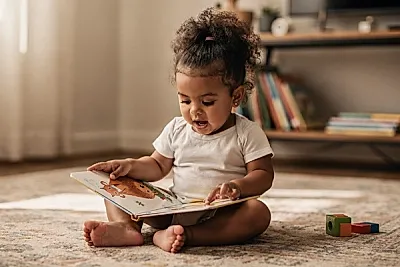
Stage 1: Board books (birth–18 months). Your baby interacts with books through their body: mouthing, grabbing, bending, staring. Board books aren't simplified picture books; they're engineered for sensory interaction first, language second. The best ones pass what we call the chew test: the baby's physical interaction with the book IS the reading experience. Start with the first five, one for looking, one for touching, one for finding, one for listening, one for gazing. → See our board book picks
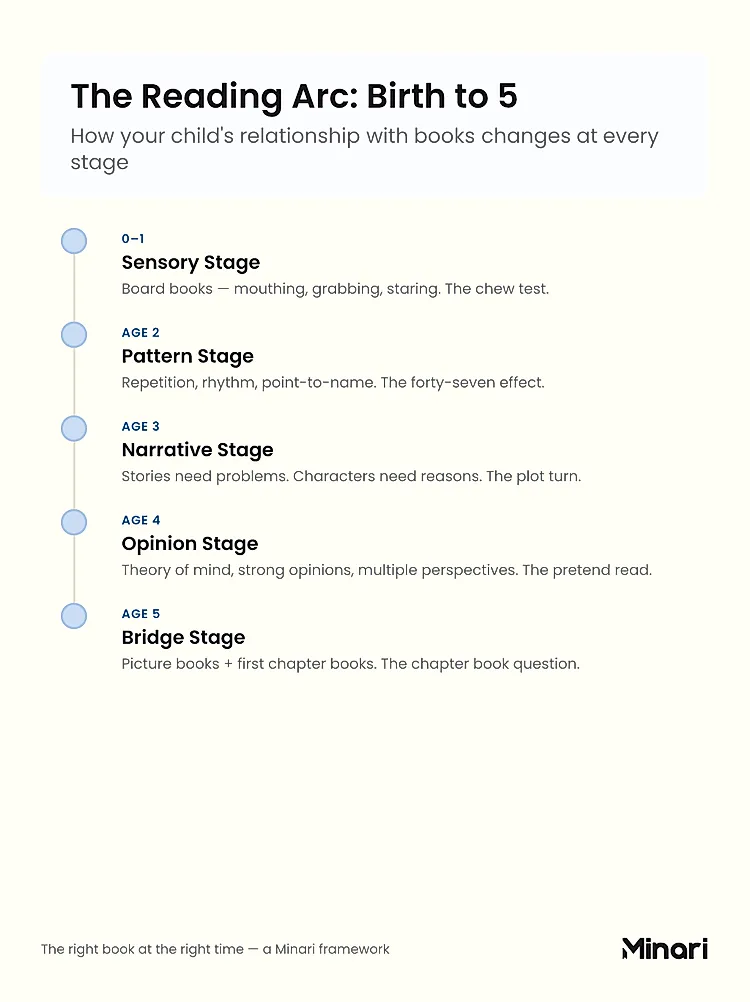
Stage 2: Pattern books (ages 2–3). Your toddler is in the repetition-and-rhythm stage. They point at everything, name everything, and want the same book forty-seven times. This is the forty-seven effect. Repetition is the mechanism that moves words from "heard once" to "mine." Books with strong refrains, predictable patterns, and point-and-name structures work here. → See our picks for 2-year-olds
Stage 3: Narrative books (age 3). Something shifts: your child starts asking "why?" They're moving from pattern-based reading to narrative-based reading, what we call the plot turn. Books now need both rhythm AND a story. Characters need problems. Pages need reasons to turn. → See our picks for 3-year-olds
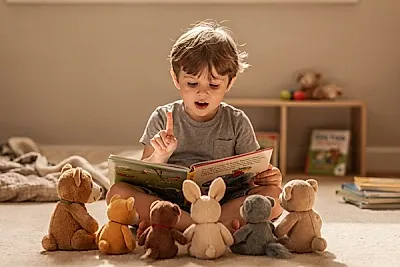
Stage 4: Opinion books (age 4). Theory of mind arrives. Your child understands that characters think and feel differently than they do. They start having opinions about stories — strong ones. They correct you when you change a word. They "read" books to stuffed animals from memory. We call that the pretend read, and it's one of the strongest pre-literacy signals a child can show. → See our picks for 4-year-olds
Stage 5: Bridge books (age 5). Picture books become more complex: moral ambiguity, open endings, real emotional weight. And the first chapter books arrive. The question every parent asks at this stage ("are they ready?") has one answer: if they remember yesterday's chapter at breakfast, they're ready. We call it the chapter book question. → See our picks for 5-year-olds
A parent who bought the "best" book for their toddler and watched it get tossed aside after two pages wasn't choosing wrong. They were choosing for the wrong stage. The book was fine. The timing was off. That's the reading arc at work, and understanding it is the single most useful thing you can learn about toddler books.
The Best Toddler Books by Age
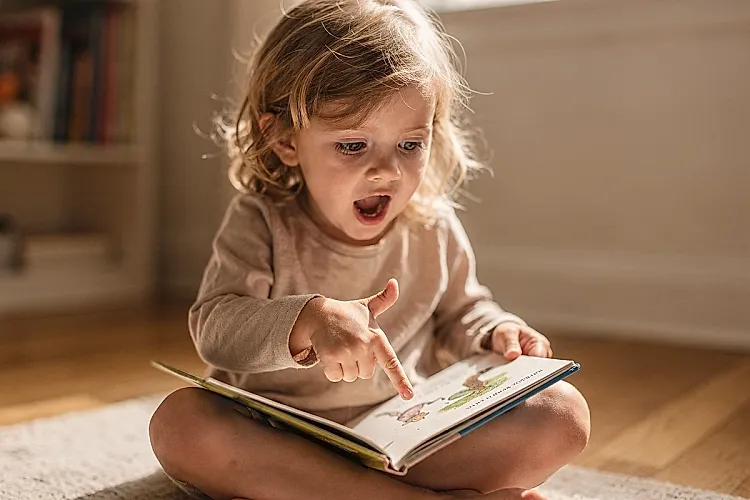
Not sure which stage your child is in? Watch their hands. Are they chewing? Board books. Pointing and naming? Pattern books. Asking "why?" Narrative books. Correcting you when you change a word? Opinion books. The behavior tells you more than their birthday does.
Age 2: The Pattern Stage
Two-year-olds read through repetition. They point at every page, name every animal, and want the same book again and again. That repetition drives vocabulary building at 150% better retention than hearing new books (Horst et al., University of Sussex, 2011). A book like Moo, Baa, La La La! by Sandra Boynton is the stage in miniature: simple enough to memorize, rhythmic enough to chant, and short enough that "again!" is always the right answer.
→ Go deeper: The Best Books for 2-Year-Olds
Age 3: The Narrative Stage
Three is when stories begin to matter. Your child shifts from pattern-based reading to following a character through a problem. The Gruffalo by Julia Donaldson is the transition book: rhyming text they can chant along with, but also a mouse with a plan, a forest full of threats, and a twist that rewards prediction. Rhythm AND story — that's what three needs.
→ Go deeper: The Best Books for 3-Year-Olds
Age 4: The Opinion Stage
Four-year-olds don't just listen to stories — they have opinions about them. They understand that characters can think and feel differently than they do, which opens up tales about friendship, mistakes, and moral complexity. The Day the Crayons Quit by Drew Daywalt is the stage in action: every crayon has a different perspective, and your child will do a different voice for each one. That's theory of mind, disguised as comedy.
→ Go deeper: The Best Books for 4-Year-Olds
Age 5: The Bridge Stage
Five-year-olds are at the top of picture books and the bottom of chapter books. Charlotte's Web is the classic first chapter-book read-aloud — Charlotte dies, and your five-year-old understands exactly what that means and needs to talk about it. Picture books and chapter books run as parallel tracks, not sequential stages. Most five-year-olds need both.
→ Go deeper: The Best Books for 5-Year-Olds
And one more thing the reading arc doesn't capture: some books work at every stage because they meet your child where their hands are, not where their comprehension is. Interactive books (lift-the-flap, touch-and-feel, push-pull-slide) channel fidgeting into learning from 6 months through age 3. And seasonal books become a category of their own: the Halloween picks and Christmas picks that reappear every year and carry memory across Octobers and Decembers. The back-to-school stretch is its own season too: books for the first day of preschool and the first day of school help a child rehearse the goodbye before a big new morning.
How to Build a Toddler Library That Grows With Your Child
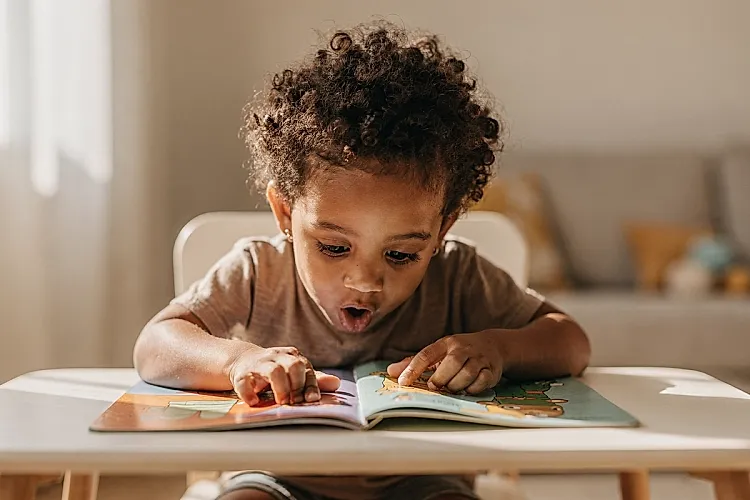
The reading arc is about buying the right books for right now and letting go of the ones your child has grown past.
Start with 5-8 books matched to your child's current stage. Not their age on a birthday card — their behavior with books right now. The behavioral heuristic from above (chewing, pointing, asking why) is your guide. Match the behavior, not the label.
Buy by behavior, not by bestseller list. The classic toddler books (the ones every list includes) are classics because they work. But they work at specific stages. Goodnight Moon is perfect at 18 months and outgrown by 3. The Gruffalo doesn't land until 3 and stays through 5. Charlotte's Web is a read-aloud for 5-year-olds, not a toddler book at all. The "best" book is always relative to the stage.
Keep three shelves. The active shelf holds books matched to right now, the ones in daily rotation. The bridge shelf holds books your child is almost ready for, the ones you'll pull down in a few months. The comfort shelf holds old favorites they still reach for. Rotate between them. When a book moves from active to comfort, something from the bridge shelf takes its place.
Let books go. The books your child loved at two did their job. Pass them to a younger sibling, donate them to the library, give them to a friend's baby. A toddler library is a conveyor belt. The best sign that a book worked is that your child outgrew it.
There will be a night — you won't know it's happening — when you read a book to your child for the last time. The board book with the chewed corner and the torn flap. The one they carried everywhere for six months. You'll close it, set it on the nightstand, and never read it again. Not because it failed. Because it finished. And the small, warm weight of a child leaning against your arm while you read? That's the thing every book in the arc is actually building, the same thing that makes bedtime stories matter long after toddlerhood ends.
If you're ready to start that nightly routine, we put together a week of illustrated stories, one in your inbox each evening, that works at any point in the arc.
Let us handle bedtime for you. 7 stories. 7 nights. Free.
One illustrated story in your inbox each evening — plus a Wonder Question to spark the kind of conversation that only happens at bedtime.
No spam. One story per night for 7 nights.
Frequently Asked Questions
There are 250,000 children's books in print. You don't need to read them all. You don't need to find the perfect one. You need about ten — and then, in a few months, a different ten.
The right book at the right time doesn't stay right forever. It works for one stage, does its job, and then your child reaches for something new. That reaching — that wanting the next book, the harder book, the book with more words and bigger problems — is the reading arc in motion.
And you started it. With the first board book you held close enough for small eyes to see.