The Best Books for 2-Year-Olds (That You'll Actually Want to Read 47 Times)
A curated list of the best books for 2 year olds: board books, picture books, and hidden gems chosen for how toddlers actually read at this age.

Minari Editor
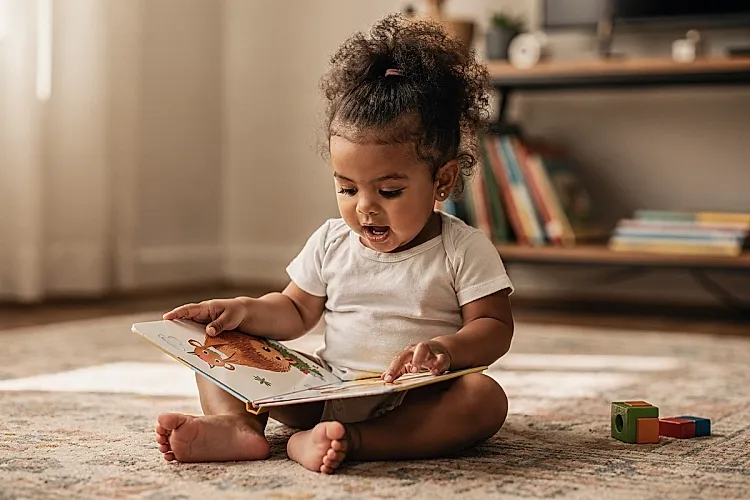
Children who hear the same book read repeatedly learn new words significantly faster than children exposed to many different books. A 2011 University of Sussex study found that toddlers who heard the same story three times in a row retained and recalled new vocabulary at more than double the rate of those who heard three different stories.
Which means the real question is which books are worth reading 47 times.
Here are 7 books for 2-year-olds chosen for how toddlers actually interact with books at this age, not just what looks good on a shelf. (They're part of a larger reading arc that changes at every stage, but age two is where the magic of repetition does its heaviest lifting.)
What makes a book work for a 2-year-old?
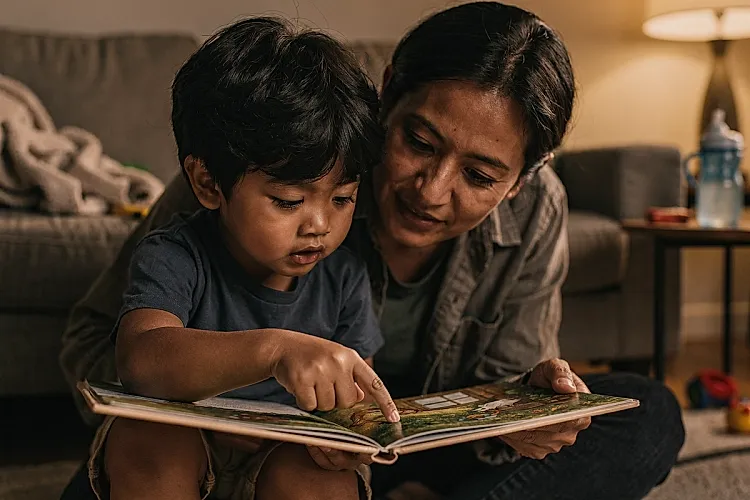
At two, your child's brain is in the middle of the most dramatic vocabulary explosion they'll ever experience. Most 2-year-olds go from roughly 50 words to 300 or more in a single year. It's a sprint.
And the books that support this sprint share three qualities.
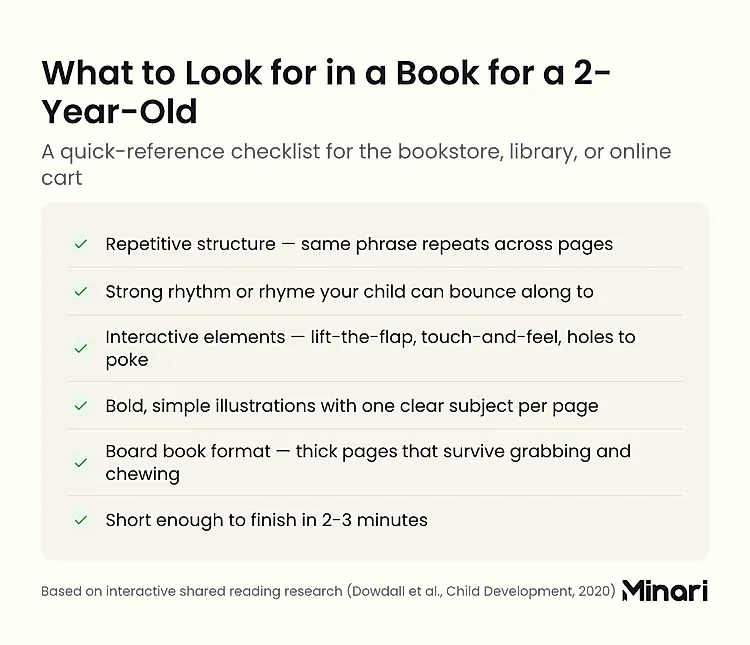
Repetition. Not a weakness — a feature. When your 2-year-old points at every animal on the page and says "doggy" regardless of species, that's not confusion. That's categorization in real time. They're testing a hypothesis: is this also a doggy? The book that repeats the same structure page after page ("Brown bear, brown bear, what do you see?") gives them a predictable frame to hang new words on.
This is what we call the forty-seven effect: the compounding benefit of reading the same book over and over. It feels like Groundhog Day to you. To your toddler, it's the mechanism that moves words from "heard once" to "mine."
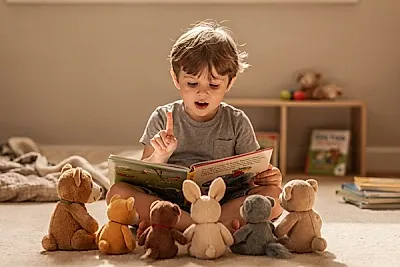
Rhythm. Two-year-olds respond to cadence before meaning. A book with strong rhythm (rhyme, alliteration, a repeated refrain) gives their brain a pattern to predict. And prediction is how language sticks. Books for 2-year-olds that lean into musicality tend to be the ones your child "reads" back to you, filling in the last word of every line.
Interaction. At this age, reading doesn't mean sitting still and listening. It means lifting flaps, poking holes, turning pages backward, and pointing at things that weren't part of the story. Research on interactive shared reading, where parents and toddlers talk about the book rather than just reading the text, shows measurably stronger language outcomes than passive listening (Dowdall et al., 2020).
The best books for toddlers age 2 are the ones that invite your child's hands into the experience.
How to read with a 2-year-old (it doesn't look like reading)
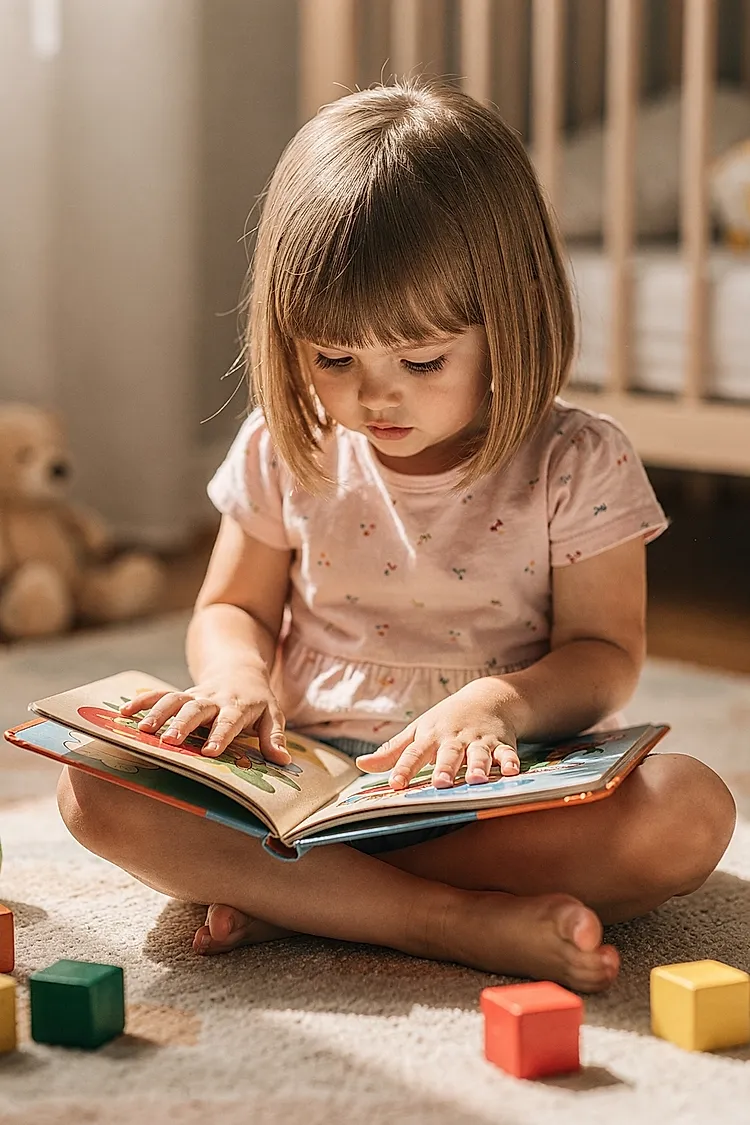
Your 2-year-old flips to the last page first. Turns back to the middle. Points at something you didn't notice. Says "again" before you've finished the first read.
This is reading at two. It doesn't look like what you imagined — and that's exactly how it should be.
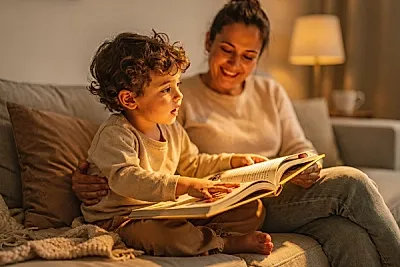
The American Academy of Pediatrics emphasizes that interactive shared reading, where parents respond to their child's cues rather than simply reading the text, is the most powerful form of early literacy. At two, the cues are physical: pointing, page-turning, bringing the book to you.
Here's what counts as reading at this age:
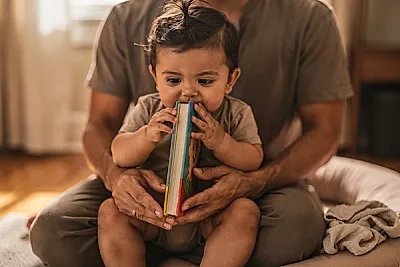
Let them hold the book. Ownership changes the dynamic. A 2-year-old who carries a favorite board book from room to room is rehearsing the story in their head.
Follow their finger, not the text. When your toddler points at the truck on page four for the sixth time, that's a conversation starter, not a derailment. Name what they're pointing at. Ask "what color?" Even a wrong answer builds the muscle.
Two minutes is plenty. A 2-year-old's attention span for focused activity is about 4-6 minutes. A board book read at toddler pace, with all the pointing and page-flipping, fills that window naturally. If your child walks away mid-book, the session was still successful.
If you've been reading together every night and want to try something new, we put together a curated set for exactly this stage: one illustrated bedtime story delivered to your inbox each evening for a full week. Use them as the fresh rotation alongside the shelf favorites.
Let us handle bedtime for you. 7 stories. 7 nights. Free.
One illustrated story in your inbox each evening — plus a Wonder Question to spark the kind of conversation that only happens at bedtime.
No spam. One story per night for 7 nights.
7 books for 2-year-olds that earn their place on the shelf
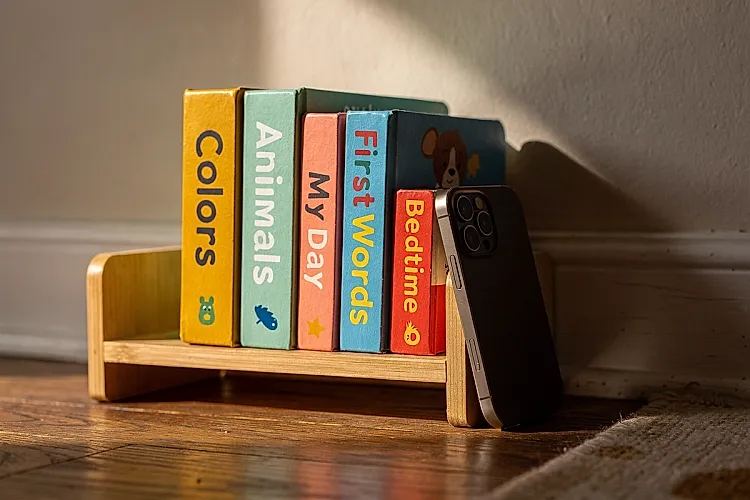
Think of this as the grab-and-point shelf: a small, curated set of books your 2-year-old can physically reach, pull out, and carry to you. At two, the act of choosing a book IS the reading experience beginning. These 7 picks are chosen for how toddlers actually use them, not how they look on an Instagram flat lay.
Moo, Baa, La La La! by Sandra Boynton
The ultimate first animal-sounds book, and it holds up on read number 47 because of Boynton's deadpan humor. "A cow says Moo. A sheep says Baa. Three singing pigs say La La La!" The absurdity is the point. Your toddler will shout along, and the rhythm is engineered for little mouths. Works equally well for books for a 2-year-old boy or girl because Boynton's animals are gloriously gender-neutral.
Dear Zoo by Rod Campbell
Lift-the-flap perfection. "I wrote to the zoo to send me a pet. They sent me a... " Every page is a prediction game, and 2-year-olds can't resist peeking. The flaps will eventually rip — that's fine. A destroyed board book is a loved board book. This one has been in continuous print since 1982 for a reason: the interactive structure matches exactly what the toddler brain craves.
Brown Bear, Brown Bear, What Do You See? by Bill Martin Jr., illustrated by Eric Carle
The repetition here is a scaffold. Every page follows the same pattern, which means by page three your child is "reading" along with you. Eric Carle's tissue-paper collage illustrations are bold enough to hold a toddler's attention, and the color-animal pairing builds vocabulary two words at a time. A household name for good reason.
Grumpy Monkey by Suzanne Lang
Jim the chimpanzee wakes up grumpy and his friends keep trying to fix it. The magic: the book validates a feeling without trying to solve it. Your 2-year-old doesn't have the words for a bad mood yet, but they recognize Jim's face. Emotional literacy starts here — not with lessons, but with a character who feels what they feel.
Chicka Chicka Boom Boom by Bill Martin Jr. and John Archambault
This one is pure rhythm. The alphabet climbs a coconut tree, the tree bends, the letters tumble — and your toddler will bounce along to the beat before they know a single letter name. It teaches the alphabet the way children actually learn: music first, meaning later. The cadence is so catchy that parents find themselves reciting it in the shower. That's the test of a great toddler book.
Escargot by Dashka Slater
The stealth pick. A French snail tries to convince your child that snails are just as lovable as bunnies or puppies — and somehow succeeds. The direct-address format ("Will you give him a kiss?") turns your toddler into an active participant. Most parents haven't heard of this one, which is exactly why it's here. The books you discover feel different from the books everyone tells you to buy. Kids who love animals tend to love Escargot's earnest persistence.
Little Blue Truck by Alice Schertle
A small blue truck tries to push a stuck dump truck free, ends up stuck too — and every animal on the farm joins in to rescue them both. The "beep beep beep" refrain is irresistible to 2-year-olds (expect them to beep at real trucks for weeks). We left Goodnight Moon off this list because most families already own it, and at two, your child is ready for stories with a little more momentum. Little Blue Truck delivers that forward motion with the same cozy warmth.
You don't need all seven at once. Two or three from this list, rotated every few weeks, will build a grab-and-point shelf your toddler treats like a treasure chest.
If your little one is approaching three and you're wondering what comes next, the best books for 3-year-olds still lean on rhythm but add a real story arc, and the overlap between ages is wider than most lists suggest. For bedtime specifically, the bedtime stories for 3-year-olds lean into that participatory style.
Frequently Asked Questions
So tonight, when your toddler hands you the same board book for the forty-seventh time, know this: you're not stuck in a loop. You're building something. Every re-read is a word learned, a pattern cemented, a small person deciding that books are worth coming back to.
That's the whole point.