The 7 Best Board Books for Babies (Even the Ones They Chew)
The best board books for babies from birth to 18 months, sturdy, beautiful, and chosen for how babies actually interact with books at every stage.

Minari Editor
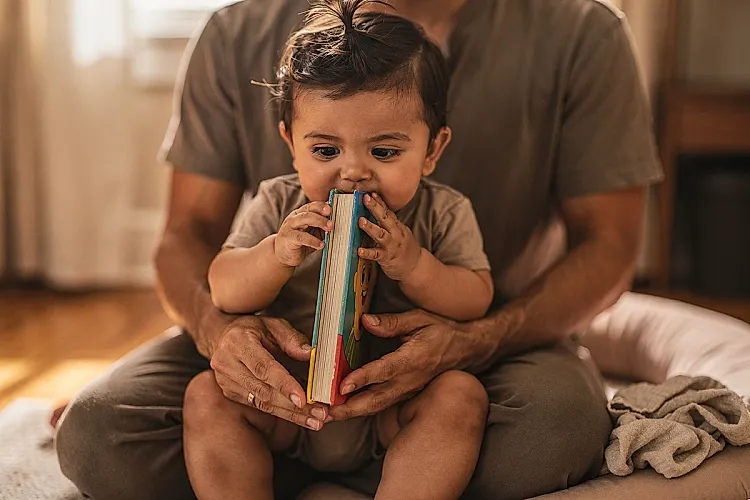
There's a board book in your house right now with a soggy corner and tiny teeth marks on the spine. You've probably wondered if it's worth buying more when this is what happens to them.
Here's the thing most book lists won't tell you: that chewed corner is the first sign the book is doing its job. Board books are designed — the page weight, the rounded corners, the size that fits in small hands — for exactly the way babies process the world before they have words for it.
The best board books for babies match where your child actually is developmentally, the first stage of a reading arc that stretches from birth to age 5, not where a recommended reading list thinks they should be. Here are seven that do that, from birth through the first year and beyond.
Why Board Books Exist (and Why They're Not Just "Baby Versions" of Real Books)
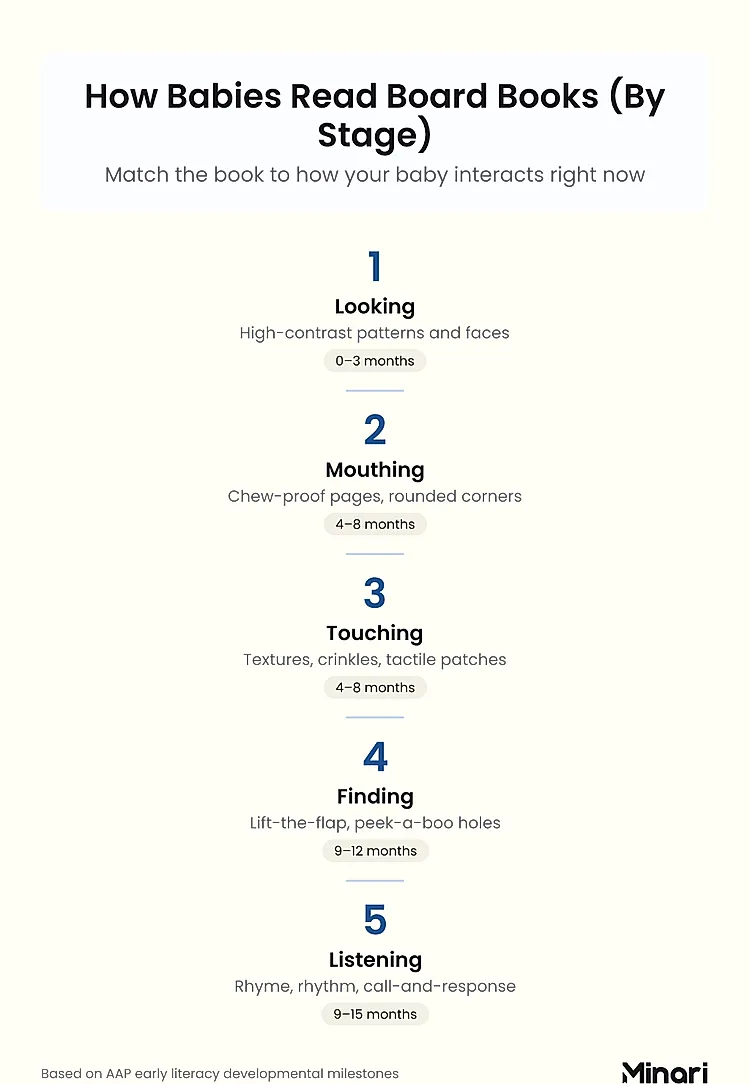
A baby's brain is doing different work at every stage of the first year, and the right board book meets them where they are, not where they'll be in six months.
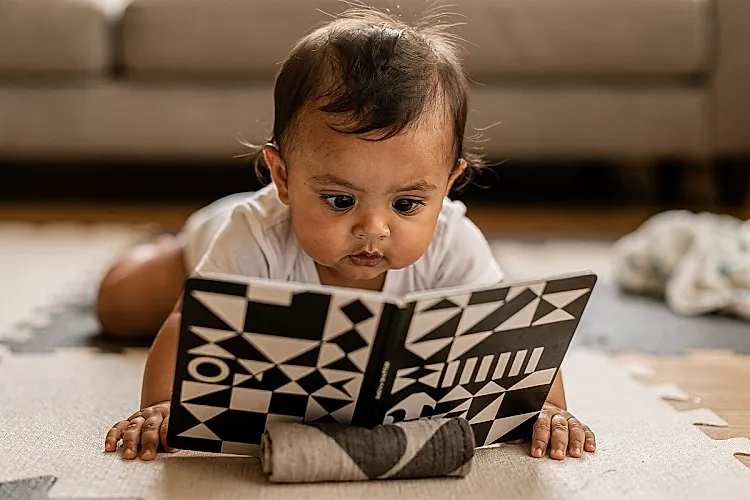
0–3 months: Your newborn can see roughly 8–12 inches in front of their face. Color vision is still developing. What they respond to? High-contrast patterns: bold black and white, simple geometric shapes, and faces. This is why the baby first book that works best for a newborn is stark, graphic, and surprisingly dramatic for something with zero words.
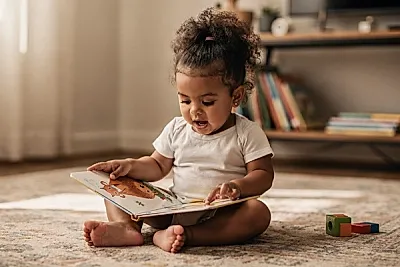
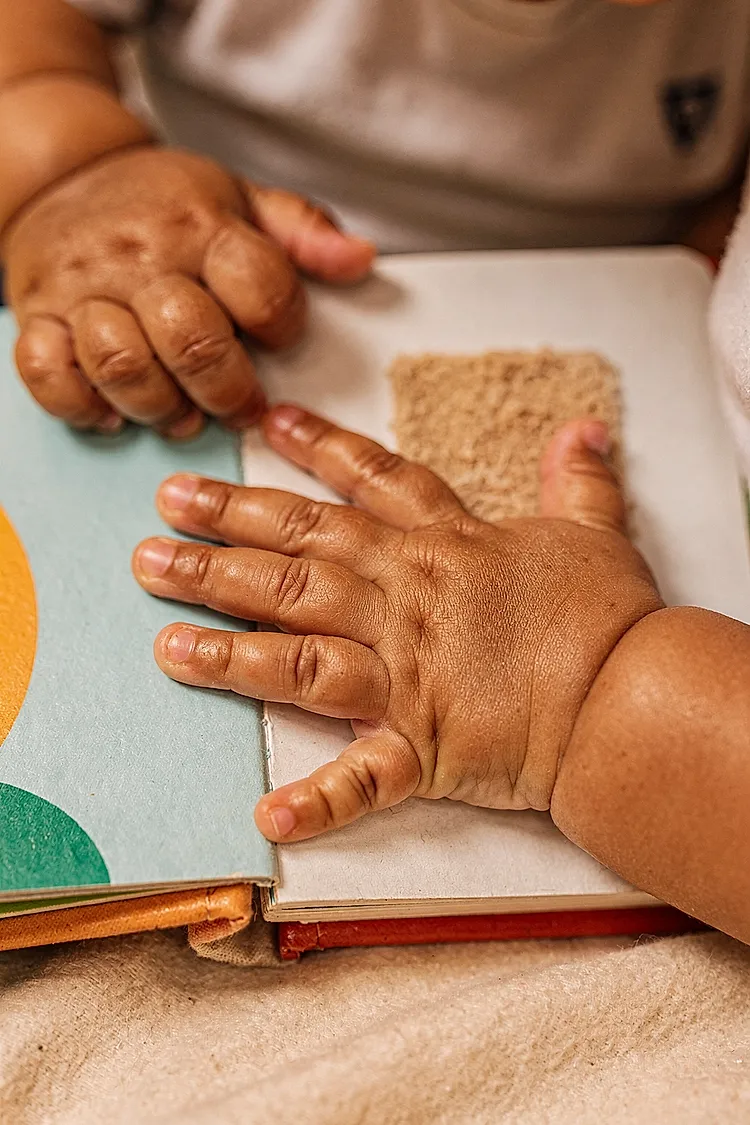
4–8 months: Now they're reaching, grabbing, and — yes — putting everything in their mouth. At this age, mouthing is one of the primary ways babies gather information about objects: texture, weight, taste, flexibility. A board book that survives this while delivering sensory input (crinkle pages, textured patches, rounded edges to gum) is doing exactly what it was designed to do.
We'd call this the chew test. A board book passes the chew test when the baby's physical interaction with it (mouthing, bending, grabbing) IS the reading experience, not a distraction from it. If your 7-month-old is gnawing on the corner while staring at a high-contrast page, that's two developmental processes happening at once. The book is working.
9–15 months: Pointing begins. Page-turning becomes intentional (if chaotic). Your baby starts connecting images to words — you say "dog" and they slap the page with the dog on it. This is when board books for 1 year olds shift from purely sensory to interactive: lift-the-flap, peek-a-boo holes, and simple call-and-response text.
The Best Board Books for Babies: 7 Picks for Every Stage
What we call the first five is a starter set that covers every way a baby under 12 months interacts with a book: one for looking, one for touching, one for finding, one for listening, and one for gazing at faces. A first library doesn't need to be big. It needs to be complete.
Here are seven picks: the first five plus two that bridge into the books for 1 year old territory.
Black & White by Tana Hoban
The looking book. No color, no story, no text — just bold black-and-white photographs of everyday objects. It sounds boring and it's anything but. Newborns are magnetically drawn to these high-contrast images because it's literally all they can see clearly. Prop it up during tummy time and watch your baby track the shapes with their eyes. That tracking is the earliest form of visual literacy. Find it on Bookshop.org
Pat the Bunny by Dorothy Kunhardt
The touching book, and the one that invented the category. Published in 1940 and still on every list for a reason. Your baby can feel Daddy's scratchy face, pat the bunny's fur, and look in the tiny mirror. The multisensory design serves a real purpose — babies build neural connections between touch and meaning through exactly this kind of input, long before they understand words. Find it on Bookshop.org
Where's Spot? by Eric Hill
The finding book. The original lift-the-flap board book, and the one that teaches object permanence through play. "Is he behind the door?" Lift. "No, it's a bear!" The reveal-and-surprise structure is perfectly calibrated for 9–12-month-olds who are just discovering that things still exist when they can't see them. Every flap is a tiny experiment in prediction. Find it on Bookshop.org
Peek-a Who? by Nina Laden
Here's the pick that surprises parents. Die-cut holes let your baby see a sliver of the next page, just enough to guess what's hiding. The rhyming text ("Peek-a... MOO!") is designed for the moment when your baby starts anticipating and filling in sounds. It's the best board books for toddlers transition book: simple enough for a 6-month-old to grab, clever enough for an 18-month-old to "read" to you. Find it on Bookshop.org
If you've built the first five and want to add regular story time into the rhythm, we put together a week of illustrated bedtime stories, one in your inbox each evening, paced for the youngest listeners.
Let us handle bedtime for you. 7 stories. 7 nights. Free.
One illustrated story in your inbox each evening — plus a Wonder Question to spark the kind of conversation that only happens at bedtime.
No spam. One story per night for 7 nights.
Baby Faces by Margaret Miller
The gazing book. Photographs of real baby faces showing different emotions: happy, sad, surprised, sleepy. Nothing is more interesting to a baby than another baby's face. Research from MIT's infant cognition lab confirms that face processing is one of the first visual skills to develop, and babies prefer looking at faces over any other visual stimulus. This book exploits that instinct beautifully. Find it on Bookshop.org
Barnyard Dance! by Sandra Boynton
The listening book. Boynton's bouncy, rhyming text ("Stomp your feet! Clap your hands! Everybody ready for a barnyard dance!") is impossible to read without rhythm, and rhythm is how babies first process language, long before they understand individual words. This is the board book that gets parents dancing in the living room, which is the entire point. Find it on Bookshop.org
Indestructibles: Baby Peekaboo by Amy Pixton
The underdog pick — and the one that genuinely changes the game for anxious parents. Indestructibles are printed on a material that's chew-proof, rip-proof, and washable. No ink that flakes, no pages that tear. They're designed for the exact stage when your baby treats every object like a stress test. If you've ever hesitated to hand your baby a book because you didn't want them to destroy it, this series exists for you. Find it on Bookshop.org
A note on what's not here: we didn't include Goodnight Moon or The Very Hungry Caterpillar. Both are extraordinary books, but they're picture-book experiences that happen to come in board-book format. Their pacing and narrative structure are designed for 2-3-year-old comprehension, not baby-stage interaction. If you have them, wonderful; your baby will grow into them. But if you're building a first library from scratch, the seven above will get more use in the first year.
How to Read to a Baby (It's Simpler Than You Think)
Here's the permission slip no one gives new parents: you don't need to read every word. You don't need to finish the book. You don't even need your baby to look at the pages.
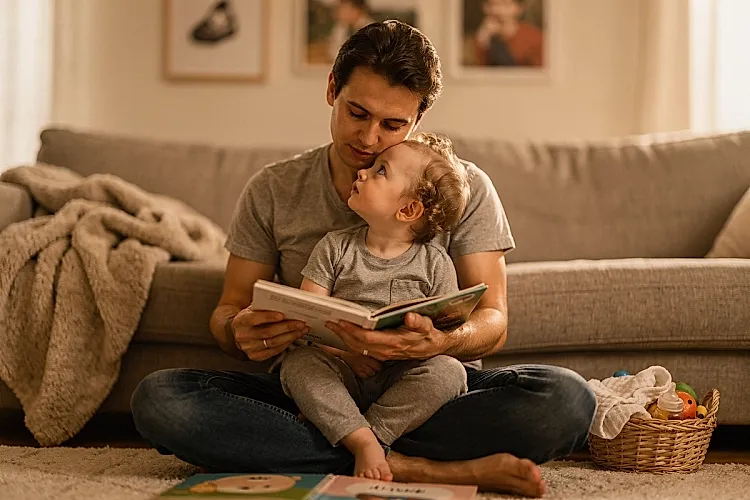
A 3-month-old who isn't looking at the book at all — who's staring at your face while you read — is still learning. They're absorbing the rhythm and cadence of language, the rise and fall of your voice, the warmth of being held while something interesting happens. The American Academy of Pediatrics recommends reading aloud from birth, not because newborns understand stories, but because the act of shared reading builds the neural architecture that stories will eventually live in.
Practically, this is what works:
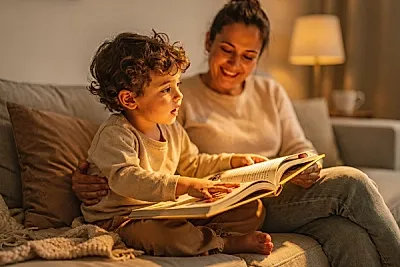
Hold them facing the book. In your lap, on your chest during tummy time, propped in a bouncer with the book angled toward them. The position matters less than the proximity (remember, 8–12 inches for newborns).
Name, don't narrate. Point at the picture and say the word. "Dog." "Ball." "Baby." At this age, labeling is more powerful than storytelling. Each word-image pairing is a brick in the foundation.
Two minutes is enough. Research from the Journal of Developmental and Behavioral Pediatrics (2019) found that children read to daily from infancy hear an estimated 1.4 million more words by age 5. That gap builds in small increments: a few minutes a day, not marathon reading sessions. Two minutes of board book time with a baby is doing more than you think.
Let them lead. If they grab the book, let them hold it. If they flip to a random page, read that page. If they close it, you're done. Reading with a baby is a conversation that hasn't found words yet.
If you're looking for books that match the next stage, the 2-year-old who points at everything, the interaction shifts, but the instinct you're building right now is what makes that stage possible.
Frequently Asked Questions
That soggy, tooth-marked board book on the floor? It's not ruined. It's been read.
And the parent who handed it over and let their baby do what babies do with it — gnaw on it, bend it, stare at it sideways during tummy time while you named every shape on the page — that parent built something. Not a reader. Not yet. But the foundation a reader will stand on.
Tonight, when you hold a book close enough for small eyes to see, you won't need to read every word. Just be there. The book will do the rest.