The Best Books for 3-Year-Olds (That Actually Match How They Think Now)
A curated list of the best books for 3 year olds, including picture books, early stories, and hidden gems chosen for the way three-year-olds actually read.

Minari Editor
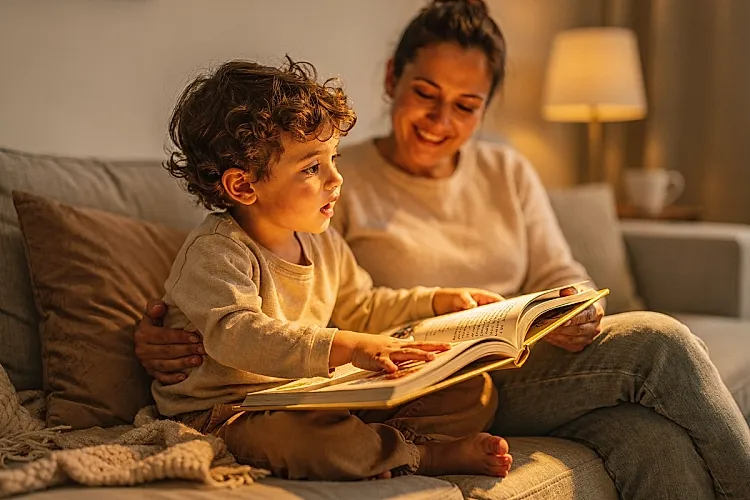
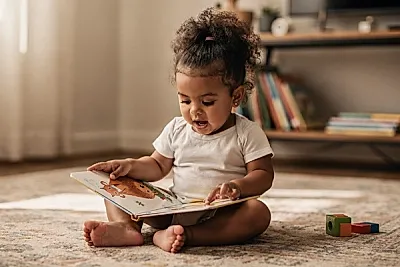
Six months ago, the board books worked. Your child would point at every animal, name every color, flip back to the start, and do it all again. Now those same books get tossed aside after two pages. The rhythm that used to hold them doesn't land anymore.
But the "big kid" picture books on the next shelf over? Some of those feel like a stretch. Too many words. Too much plot. Your three-year-old loses interest before the character even gets into trouble.
The books that work at three sit in a space most lists don't show you, a middle stage in the reading arc from board books to chapter books where stories need enough structure to hold a growing imagination, but enough repetition to feel safe. Here are seven that hit that spot, along with what's actually changing in your child's brain that makes this age so different from two.
What Changes About Reading at Age 3?
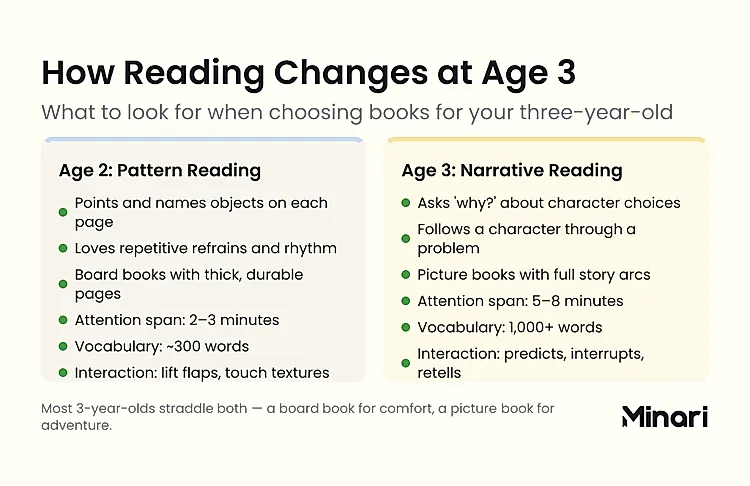
Something shifts around the third birthday, and you'll notice it before any milestone chart tells you to look for it. Your child starts asking why.
Not "what's that?" — they've been doing that since eighteen months. But "why did the bear go in the cave?" or "why is she sad?" These questions signal a cognitive leap that researchers call the beginning of narrative comprehension. Your child is no longer just recognizing patterns on a page. They're following a character through a problem.
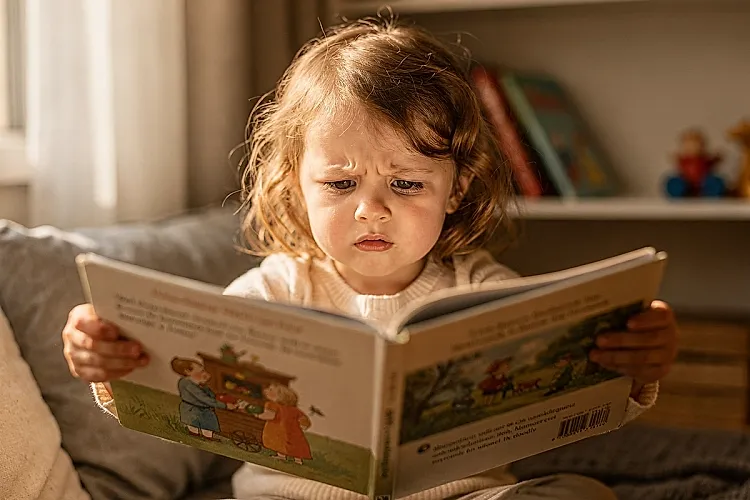
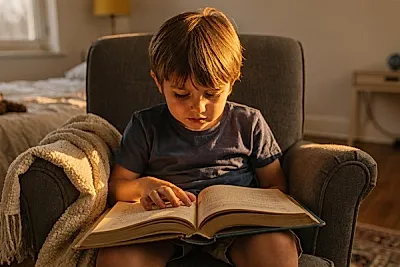
This is what we'd call the plot turn: the developmental moment when a child shifts from pattern-based reading (repeating, pointing, naming) to narrative-based reading (tracking cause and effect, anticipating what happens next). Most three-year-olds are mid-turn. They still love the rhythm of a good refrain, but now they also need a reason to keep going — a character who wants something, a problem that needs solving, a surprise that catches them off guard.
The practical result? When you're searching for the best books for toddlers age 3, the board books built for two-year-olds, with their short, repetitive text and point-and-name structure, start feeling thin. But that doesn't mean you need to abandon them overnight. Research suggests the average three-year-old's vocabulary has ballooned to over 1,000 words, and their attention span has stretched to roughly 5–8 minutes, enough for a full picture book with a beginning, middle, and end.
The board-book-to-picture-book transition is a bridge, not a cliff. And many three-year-olds happily straddle both formats for months: a board book for comfort, a picture book for adventure. If your child still reaches for Moo, Baa, La La La! before bed but also sits through The Gruffalo at story time, that's healthy range.
7 Books for 3-Year-Olds That Earn a Spot on the Shelf
Every three-year-old has what we'd call an overnight shelf: the three or four books they insist on keeping within arm's reach at bedtime. Not to read again. Just to have. The overnight shelf is the truest test of whether a book has landed. These seven are the kind that earn that spot.
The Gruffalo by Julia Donaldson, illustrated by Axel Scheffler
The household name on this list for a reason. A small mouse outwits every predator in the forest by inventing a terrifying creature — and then meets it. The rhyming text is pure three-year-old fuel: predictable enough to chant along with, surprising enough to keep the stakes alive. Kids at this age love the mouse's cleverness, and they'll start "reading" it to you within a week. Find it on Bookshop.org
Dragons Love Tacos by Adam Rubin, illustrated by Daniel Salmieri
The absurd premise (dragons will come to your party, but only if there are tacos, and absolutely no spicy salsa) is exactly the kind of logic that three-year-olds find hilarious. It's also a stealth lesson in cause and effect: what happens when you break the rules? Chaos. Delicious, illustrated chaos. The humor works because it treats your child's sense of the ridiculous with total seriousness. Find it on Bookshop.org
The Wonderful Things You Will Be by Emily Winfield Martin
This is the book that makes parents cry in the bookstore — and the one three-year-olds carry to bed without being asked. Martin's oil-painting illustrations have a richness you can feel through the page (thick brushstrokes, layered colors, characters in costumes and capes), and the text speaks directly to the child: "I wonder what you'll be." Your three-year-old won't understand all of it. But they'll lean into you while you read it, and that's the overnight shelf earning its name. Find it on Bookshop.org
Not Quite Narwhal by Jessie Sima
Here's the pick you won't find on most lists. A unicorn raised by narwhals discovers it doesn't quite fit in — then finds out where it does. The illustrations are soft pastels and underwater light, the kind of pages a three-year-old traces with a finger. And the identity theme lands at exactly the age when children start noticing that not everyone looks or acts the same. Watch your child's face when the unicorn finds its herd — that's recognition, not just a happy ending. Find it on Bookshop.org
If the overnight shelf could use a few new additions for this stage, we put together a set of illustrated bedtime stories, one in your inbox each evening for a week. Use them as the next read-aloud adventure, or as the familiar anchor alongside a library haul.
Let us handle bedtime for you. 7 stories. 7 nights. Free.
One illustrated story in your inbox each evening — plus a Wonder Question to spark the kind of conversation that only happens at bedtime.
No spam. One story per night for 7 nights.
Little Blue Truck Leads the Way by Alice Schertle, illustrated by Jill McElmurry
If your child loved Little Blue Truck at two, this sequel is the natural next step: the same friendly truck, but now navigating a city instead of a farm. The shift from familiar country setting to busy urban streets mirrors what three-year-olds are experiencing cognitively: more complexity, more characters, more to process. And the refrain ("Beep! said Blue") still invites them to join in. Find it on Bookshop.org
Ada Twist, Scientist by Andrea Beaty, illustrated by David Roberts
Ada's relentless curiosity (she asks "why?" approximately forty times per reading) mirrors exactly where your three-year-old is developmentally. The rhyming text is dense enough to reward re-reads, and the message (asking questions is a good thing, even when adults find it exhausting) gives permission to both the child and the parent. This is the book that makes the "why" phase feel like a feature, not a bug. Find it on Bookshop.org
Last Stop on Market Street by Matt de la Peña, illustrated by Christian Robinson
A Newbery Medal winner that actually works for three-year-olds (rare for an award book). CJ rides the bus with his grandmother and asks why they don't have a car, why they don't have certain things. Nana's answers are warm, specific, and never preachy. Robinson's cut-paper collage illustrations use flat shapes and saturated color — the kind of compositions where a three-year-old can read a character's mood from across the room. And CJ's questions are the plot turn happening on the page: a child who isn't just naming what he sees but asking why the world works the way it does. Find it on Bookshop.org
A note on what's not here: we left off The Very Hungry Caterpillar. It's a masterpiece, but it's built for two-year-old cognition: counting, naming, pattern recognition. By three, most kids have outgrown its structure even if they still love the pictures. If your child still asks for it, great — it's earning its place. But if you're buying new books for this age, there are better fits.
How to Read With a 3-Year-Old (Hint: Let Them Interrupt)
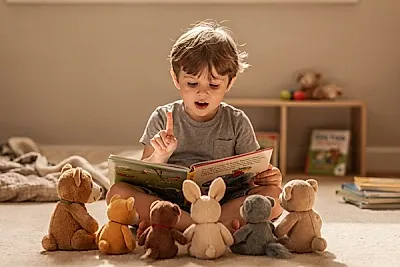
At two, reading meant your child sat in your lap and you turned pages. At three, reading means your child won't let you finish a sentence because they need to tell you what the character is feeling. This is not a problem. This is comprehension happening out loud.
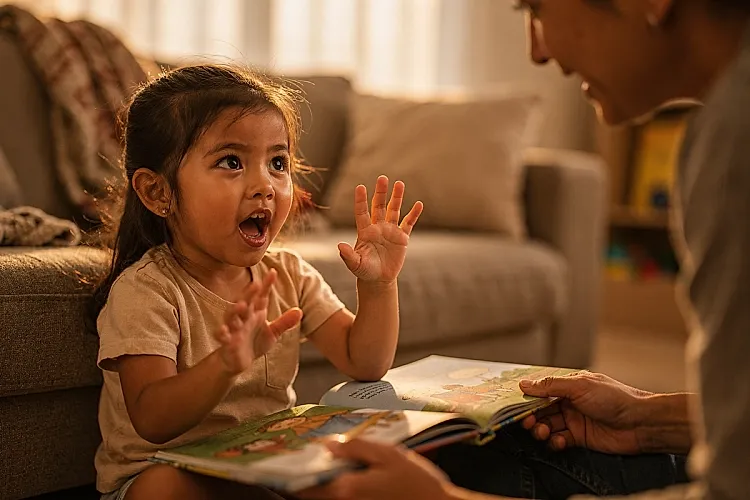
Researchers call it dialogic reading: the practice of turning a read-aloud into a conversation rather than a performance. A landmark study by Whitehurst et al. (Developmental Psychology, 1988) found that children whose parents asked questions during reading built vocabulary significantly faster than children who listened passively. The technique is simple: pause before you turn the page. Ask "what do you think happens next?" Follow their tangent before returning to the text.
Three-year-olds are also developing what early childhood researchers call theory of mind — the understanding that other people (and characters) have feelings and thoughts different from their own. When your child points at a picture and says "she's scared!" before you've read the words, that's a developmental milestone you're watching in real time.
Here's what this means practically: the "right" way to read with a three-year-old looks messy. They'll interrupt. They'll flip backward. They'll ask you to re-read the page where the dragon sneezes fire in Dragons Love Tacos for the fourth time, not because they didn't understand it, but because they're mid-plot-turn, savoring the moment where cause meets effect and the surprising thing happens. And when CJ asks his grandmother "how come we don't have a car?" in Last Stop on Market Street, that's dialogic reading happening naturally. The book is built for it. Let them interrupt. Every question is a sign the book is working.
If you're looking for stories that match this read-aloud style, the best bedtime stories for 3-year-olds lean into exactly this kind of participatory reading.
Frequently Asked Questions
The stack will change. That's the point.
Six months from now, the overnight shelf will look different — longer books, stranger characters, plots that take real turns. And you'll notice because you've been watching: the child who used to point at every animal is now the child who stops mid-page and says "she's scared" before you've read the words. That's who they're becoming.
But tonight, the book they won't let go of? The one with the page they make you read three times because the surprising thing happens and they need to feel it again?
You're keeping up. And that book is proof.