What Kind of Bedtime Stories Actually Work for 3-Year-Olds?
Three-year-olds need stories that match how they listen: short, rhythmic, and inviting enough to hear again tomorrow. Here's how to choose the right ones.

Minari Editor
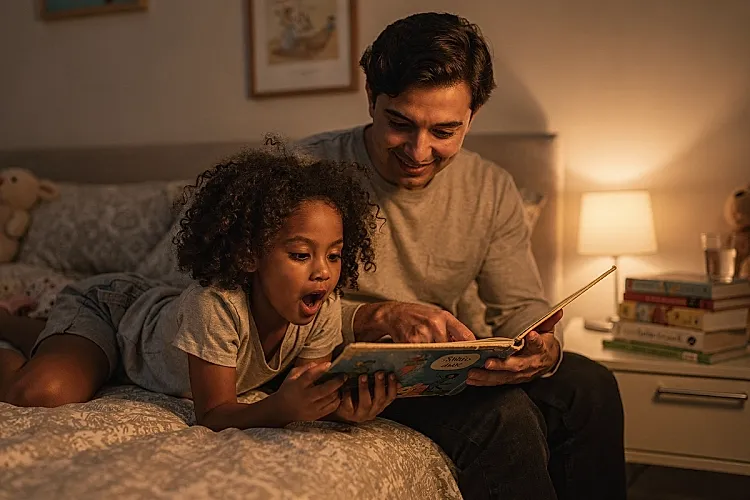
You hear the feet before you see them. Soft, bare pads on the hallway floor — for the third time tonight. Your 3-year-old appears in the doorway clutching a stuffed animal, looking wide awake despite the two books you just read.
Here's what probably happened: the story didn't match how your child listens right now.
Three-year-olds don't need long stories or complicated plots. They need bedtime stories built on pattern, rhythm, and repetition, stories short enough to finish before their attention drifts, and familiar enough to feel like a warm blanket they already know. The right bedtime story for a 3-year-old is about how the words feel in their mouth when they try to say them along with you.
Here's what's actually going on at this age, and what to reach for instead.
What makes a bedtime story work for a 3-year-old?
At age 3, your child is in the middle of a language explosion. They know around 1,000 words and are learning new ones every day. They can follow a simple narrative (a character wants something, something happens, it resolves) but multi-thread plots or stories with more than two or three characters lose them fast.
This is the developmental sweet spot for bedtime stories for 2-3 year olds and bedtime stories for 3-4 year olds alike: the window where rhythm matters more than plot. A 3-year-old doesn't care what happens to the caterpillar. They care that the caterpillar eats through one apple, two pears, three plums — and they know what comes next.
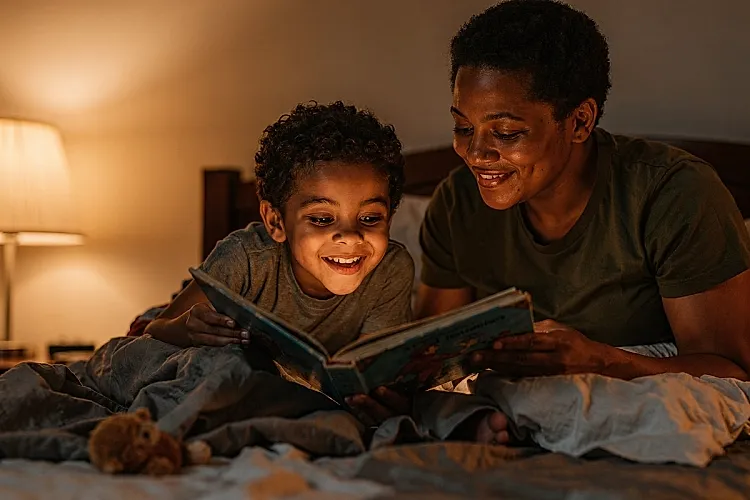
That predictability is the whole point. We call this "the echo page": the moment in a story where your child can chant along or fill in the next word before you say it. Books with echo pages become bedtime anchors. Your child is performing the story, not just listening to it.
Picture this: a 3-year-old with eyes squeezed shut, chanting the last word of every rhyming line a full beat before you get there. That's not memorization. That's a child whose brain is building phonological awareness, the skill that predicts reading success years later.
The difference between a 2-year-old and a 3-year-old listener? At 2, they point at pictures. At 3, they narrate them. Stories that invite this participation (asking "what's that?", leaving pauses, repeating a phrase) are the ones that work at bedtime. If your child is between these ages, they'll likely respond to the same books. The right bedtime stories for 5 year olds shift significantly, because by then, attention spans and narrative comprehension have doubled.
How long should a bedtime story be for a 3-year-old?
Short. Shorter than you think.
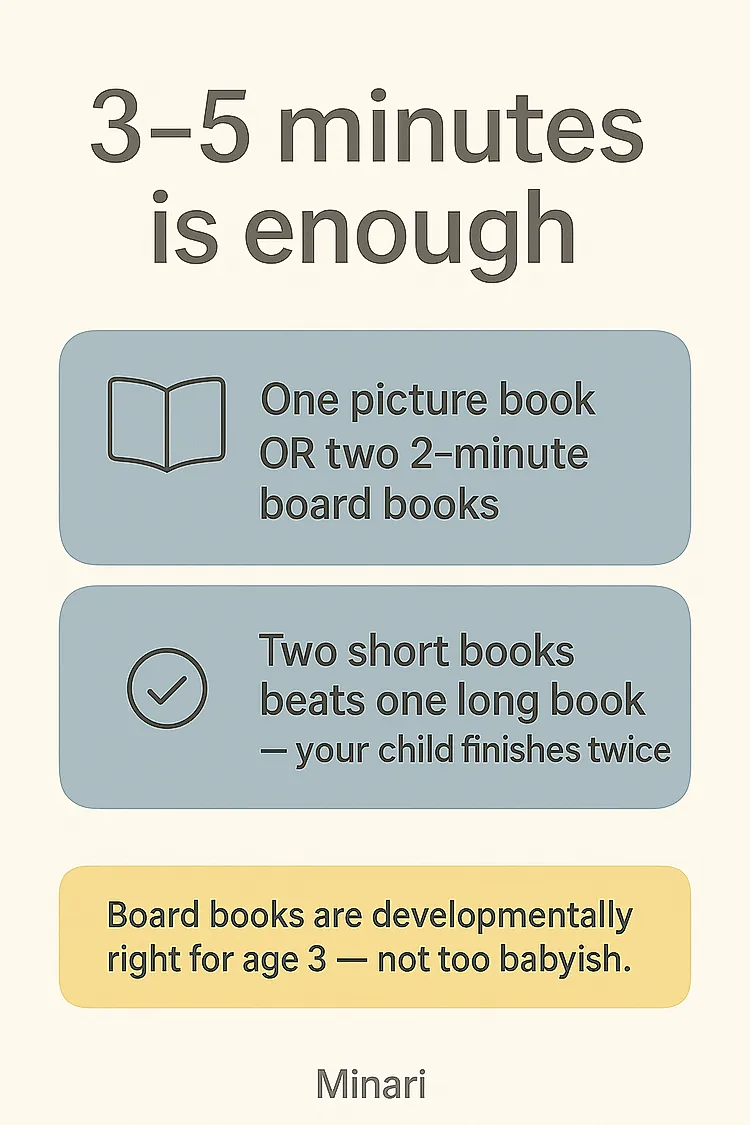
Research on preschooler attention spans suggests 3-5 minutes of focused listening is realistic for a 3-year-old at bedtime, when they're already tired, already stimulated from the day, and not sitting in a structured classroom environment. That's one picture book. Maybe two board books.
And that's enough.
Here's a permission slip most parents need: two very short books beat one medium book at this age. A 3-year-old who makes it through two 2-minute board books feels the accomplishment of "finishing" twice. A 3-year-old who squirms away halfway through a 10-minute story feels like bedtime reading is something to escape.
Board books still work beautifully at age 3 — and this surprises parents who think they should have "graduated" to picture books by now. The physical format matters: board books are sturdy enough for toddler hands, chunky enough to flip with imprecise fingers, and short enough to read twice if your child asks. They're perfectly age-appropriate.
If your child is ready for something slightly longer, 5-minute bedtime stories are the natural next step, but don't rush there. A 3-year-old who loves a 2-minute board book is exactly where they should be.
What kinds of stories do 3-year-olds love most?
Not all bedtime story books for 3 year olds are created equal. If you're also building a daytime shelf, our best books for 3-year-olds covers the full range. Here's what works at bedtime specifically, and why.
Rhyming and rhythm books dominate bedtime for 3-year-olds, and there's a reason. At this age, your child's brain is wiring for phonological awareness, the ability to hear and manipulate sounds in language. Rhyming books are basically stealth literacy training disguised as fun. The bedtime stories for 3-4 year olds that get requested night after night are almost always the ones with a strong rhythmic backbone.
Animal stories are a close second. Three-year-olds are in a phase where animals feel more relatable than human characters, partly because animal characters are simpler, partly because a bear going to bed is less loaded than a child going to bed (no one argues with a sleepy bear).
This is what we call "the join-in shelf": bedtime story books for 3 year olds where your child participates rather than passively listens. They roar with the bear, whisper with the mouse, count the stars on the page. The best books at this age are the ones your child performs.
A few worth trying:
- *Each Peach Pear Plum* by Janet and Allan Ahlberg. A rhyming "I spy" game through fairy tale characters. The rhythm is so reliable your child will be finishing lines within three readings. (Household name)
- We're Going on a Bear Hunt by Michael Rosen. Participatory, rhythmic, and the "swishy swashy" sounds are irresistible at this age. Three-year-olds act it out in bed. (Household name)
- The Napping House by Audrey Wood. A cumulative story where everyone piles onto the bed and falls asleep. The repetitive stacking structure is pure echo-page gold. (Librarian favorite)
- I Am a Bunny by Ole Risom, illustrated by Richard Scarry. Short, gentle, and the seasons-based structure gives it a calming inevitability. Under-recommended for bedtime. (Underdog pick for this context)
- Shh! We Have a Plan by Chris Haughton. Four characters try to catch a bird using progressively elaborate plans. The repeated "shh!" turns every reading into a whisper game. (Librarian favorite)
- Time for Bed by Mem Fox. A parade of animal parents putting their babies to sleep. The gentle rhyming text and soft illustrations were designed specifically for the bedtime moment. (Librarian favorite)
A 3-year-old roaring along with a storybook bear, then immediately dropping to a whisper because the bear is going to sleep — that's emotional regulation practice disguised as play. The story is teaching your child to shift their own energy down, one page at a time.
How to make bedtime reading stick when your 3-year-old won't sit still
First, reframe what "working" looks like. A 3-year-old who fidgets, flips pages ahead, or wants to hold the book upside down is still engaged. The goal is participation.
Three practical things that help:
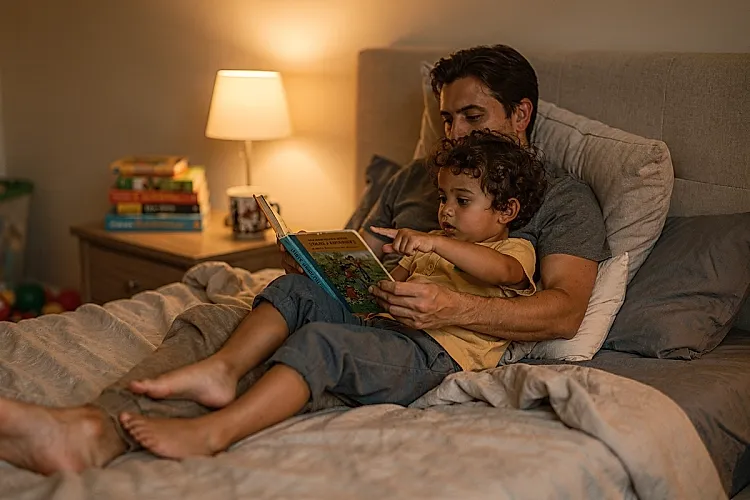
Read in the bed, not on the couch. The physical location matters more than parents realize. A 3-year-old who associates the bed with stories starts to associate the bed with winding down. If you read on the couch and then transfer them, you've broken the ritual.
Use the same book for a full week. This sounds tedious. It's not — for your child. At age 3, hearing the same story repeatedly is how they process it. By day 3, they're filling in words. By day 5, they're "reading" it to you. By day 7, they've internalized the story's rhythm as part of their sleep ritual. Research from the University of Sussex found that children who heard the same story multiple times retained new vocabulary 150% more effectively than those who heard a different story each session.
Let them hold the book. A 3-year-old who holds the book controls the pace. They might skip pages, linger on the bear illustration for two full minutes, or close the book and hand it back to you — and all of that is fine. Ownership creates investment.
"The single most important activity for building the knowledge required for eventual success in reading is reading aloud to children."
You don't need to find seven books to try this. We built a set for exactly this stage: one illustrated bedtime story in your inbox each evening, paced for a 3-year-old's attention span. Use them as your anchor book for the week, or as the "explorer" alongside a shelf favorite.
Let us handle bedtime for you. 7 stories. 7 nights. Free.
One illustrated story in your inbox each evening — plus a Wonder Question to spark the kind of conversation that only happens at bedtime.
No spam. One story per night for 7 nights.
Frequently Asked Questions
Tonight, when small feet pad back down the hallway, try something different. Pick the shortest book on the shelf, the one with the rhyme your child already knows by heart. Read it once. Read it again if they ask. And when they whisper the last word before you do, eyes already half-closed — that's a reader being built, one echo page at a time.