Why 5-Minute Bedtime Stories Work Better Than You Think
Five-minute bedtime stories hit the sweet spot for busy nights. Here's why short stories work, what to look for, and the best options for your family.

Minari Editor
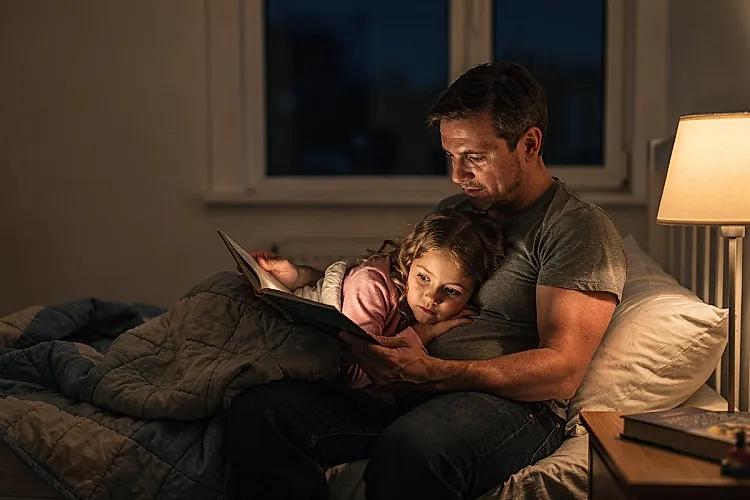
It's 8:37 PM. Bedtime was supposed to be 8:00. Your child is finally in pajamas but nowhere near sleep, and you're doing the math — is there even time for a story tonight?
There is. Because a 5-minute bedtime story isn't a lesser version of a "real" reading session. It's often the better one. Research on reading frequency consistently shows that daily reading, even in short sessions, builds far greater vocabulary exposure than longer but infrequent sessions. By age 5, children read to daily have heard an estimated 296,000 story words, compared to just 63,000 for children read to once or twice a week, according to a 2019 study published in the *Journal of Developmental and Behavioral Pediatrics*.
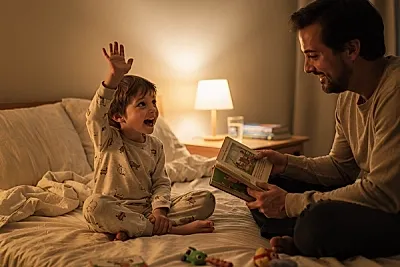
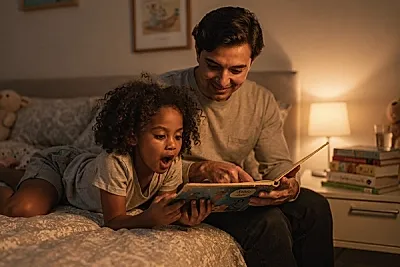
And here's the part no one tells you: the guilt you feel about keeping it short? That's the myth talking. The reality is that five minutes of focused, connected reading (your child pressed against your side, following a character through a tiny adventure) does exactly what bedtime stories are supposed to do. It calms. It connects. It makes tomorrow's bedtime something to look forward to.
Why do short bedtime stories work so well?
Every 5-minute bedtime story is working with biology, not against it. During the day, a kindergartener can sustain focused attention for about 12-15 minutes. But bedtime isn't daytime. By 8 PM, your child has burned through a full day of stimulation, regulation, and learning. Their remaining attention window is closer to 5-7 minutes — and a story that fits inside that window lands completely.
This is the difference between a story your child absorbs and one they fidget through.
A 2021 study published in *Pediatrics* found that children enrolled in sustained early reading programs showed a 15-percentage-point improvement in kindergarten readiness scores over two years, with researchers noting that consistent, cumulative exposure to books, rather than any single long session, drove the outcome. It's the nightly ritual, not the runtime, that builds early literacy.
Some books have what librarians call story gravity: they pull a child back night after night, not because they're long or complex, but because something in the rhythm, the characters, or the ending clicks. A 5-minute story with story gravity builds more reading momentum than a 30-minute session that happens sporadically, which is why our guide to bedtime stories for kids puts frequency above every other variable. The child who begs for The Kissing Hand every Tuesday is building mastery, one repetition at a time.
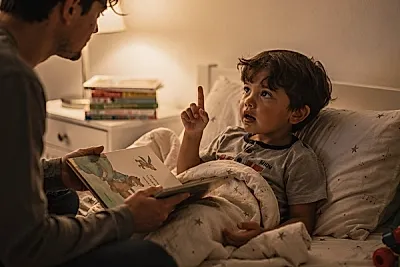
There's a moment that tells you short was exactly right: your child drifts off mid-sentence, mouth slightly open, hand still resting on the page. You didn't need another chapter. You needed that story, at that length, tonight.
Funny or calming: which 5-minute stories work best before bed?
Here's a myth worth retiring: that funny stories before bed will "wind them up." The opposite is often true. Laughter triggers a parasympathetic response — the body's natural relaxation system. After a burst of giggles, heart rate and muscle tension drop below their pre-laughter baseline. A child who laughs hard at a silly story is actually discharging the energy that was keeping them awake.
The real answer is simpler: read the room.
If your child is wired (bouncing on the mattress, asking for water, negotiating one more minute), a funny story meets them where they are. The giggles burn off the last charge. Try *Don't Let the Pigeon Stay Up Late!* by Mo Willems (a pigeon deploying every bedtime stall tactic your child has ever tried, and they'll recognize themselves immediately) or *The Book With No Pictures* by B.J. Novak, which takes about four minutes and guarantees at least one belly laugh.
If your child is already drowsy, rubbing eyes, voice getting quieter, a calming story eases them the rest of the way. Goodnight Moon by Margaret Wise Brown remains the gold standard for a reason: its rhythm is hypnotic. For something less well-known, try A Lovely Day for Amelia Goose by Yu Rong, spare, gentle, and finished in under five minutes.
A 4-year-old so overtired he's practically vibrating. You reach for a calming book and he swats it away. You try *Llama Llama Red Pajama* by Anna Dewdney instead, all four minutes of it, and by the last page his breathing has slowed to match the rhythm. Sometimes the right 5-minute funny bedtime story is the fastest path to quiet.
If you're looking for stories that fit inside five minutes and hold up night after night — we curated a week's worth. One illustrated bedtime story in your inbox each evening, for seven nights.
Let us handle bedtime for you. 7 stories. 7 nights. Free.
One illustrated story in your inbox each evening — plus a Wonder Question to spark the kind of conversation that only happens at bedtime.
No spam. One story per night for 7 nights.
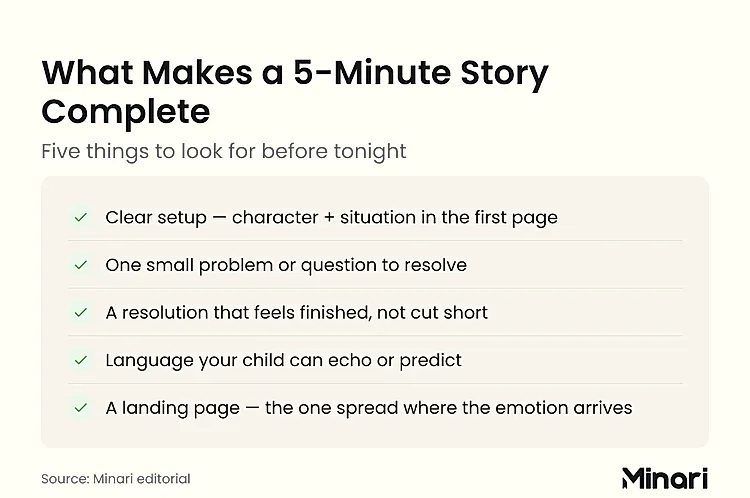
What to look for in a 5-minute bedtime story book
Not all short story collections are created equal. The best 5-minute bedtime stories books share a few traits that make them actually work at bedtime, not just on paper.
Look for clear time markers. Collections that label each story's reading time (3 minutes, 5 minutes, 7 minutes) let you choose based on how much runway you have tonight. The Usborne Five-Minute Bedtime Stories collection and Five-Minute Stories: Over 50 Tales and Fables both do this well. Disney's 5-Minute Stories series is popular but runs long — some "5-minute" stories clock closer to 8, which matters when bedtime is already late.
Variety over theme. A collection with fairy tales, animal stories, silly adventures, and gentle poems gives you something for every mood. Single-theme collections (all princess stories, all dinosaur stories) work great for a week, then gather dust.
Age-appropriate range matters. A book marketed for "ages 2-8" usually means it works well for no one in particular. Look for collections that target a narrower band (ages 3-5 or 4-6) so the vocabulary and story complexity actually match your child's comprehension.
Print vs. digital is a real choice. Physical books have the tactile advantage — the page-turning, the illustrations, the weight of the book in small hands. But digital options (apps, audiobooks) have their place: travel, shared-custody transitions, nights when the bookshelf is in the other room. A bedtime story for a 5-year-old works in whatever format gets it read consistently.
The format matters less than the habit.
How to make 5 minutes feel like enough

The secret to a satisfying 5-minute bedtime story is the frame around it.
A systematic review of bedtime routine studies (Mindell & Williamson, *Sleep Medicine Reviews*, 2017) confirmed what exhausted parents already suspect: children who follow a predictable bedtime sequence, including a short story at the same point every night, fall asleep more quickly and wake less often during the night. The consistency is the sedative, not the story length.
But here's the part that transforms a 5-minute story from adequate to magical: the cliffhanger close. When your child asks for more (and they will), don't feel guilty about saying "we'll start right here tomorrow." You've just turned tonight's ending into tomorrow's beginning. A child who goes to bed anticipating a story is running toward bedtime, not away from it.
One kindergarten teacher in Portland keeps a sign by her classroom reading corner: "We stopped at the good part." Her students arrive in the morning asking to hear what happens next. That's the cliffhanger close working at scale, and it works just as well at 8:37 PM on your couch.
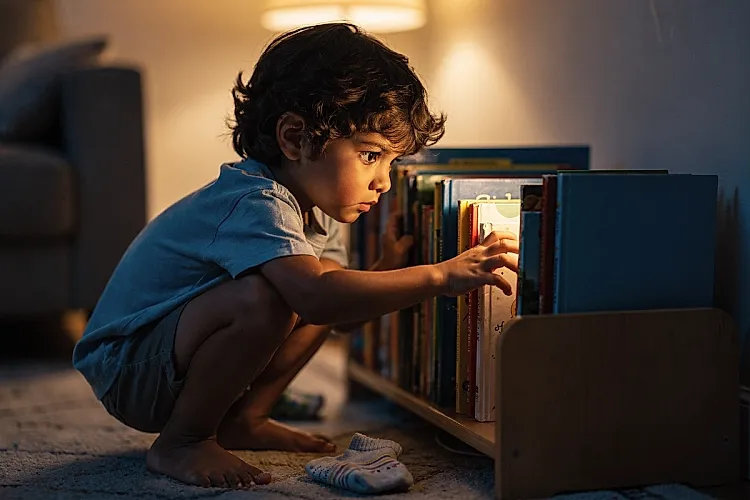
Keep 3-5 books on a low shelf your child can reach. Let them choose. A child who picks their own 5-minute story is invested before you read the first word — and when they reach for the same book tomorrow night, they're in a comfort loop: repetition that helps them process emotions, build prediction skills, and feel safe.
Frequently Asked Questions
It's 8:42 PM now. Five minutes have passed. Your child's hand is still resting on the page, but their eyes are closed.
You didn't need more time. You needed that story, at that length, tonight. Tomorrow they'll ask for it again — same book, same page, same five minutes. That's the comfort loop doing its work. And it's the whole point.