The Parent's Guide to Bedtime Stories for Kids: By Age, Length, and What Actually Works
Bedtime stories build vocabulary, improve sleep, and strengthen bonds. Here's what to read at every age, how long, and the framework that makes it work.

Minari Editor

A child read to every day is exposed to roughly 290,000 more words by the time they start kindergarten than a child who is never read to. For families who read five books a day, that gap grows to nearly 1.5 million words, a difference that shows up in vocabulary, reading readiness, and how confidently a child enters a classroom.
That number comes from a 2019 study in the *Journal of Developmental and Behavioral Pediatrics*, and it's one of the most consistent findings in early childhood research. But here's what the study doesn't tell you: which bedtime stories to read, how long to read them, or what changes as your child grows from two to seven.
That's what this guide is for. It's the map. The detailed trails are in the age-specific and format-specific guides linked throughout — each one written for the parent who needs it tonight.
Why Bedtime Stories for Kids Are the Most Effective 5 Minutes of Your Day
You already know reading to your child is important. What you might not know is that bedtime reading specifically (not morning reading, not audiobooks in the car, not storytime at the library) occupies a unique developmental position that no other activity replicates.
Here's why: bedtime is the only time of day when three conditions converge.
Your child's nervous system is winding down. In the transition between wakefulness and sleep, the brain is consolidating the day's experiences and is unusually open to new input. A story read during this window doesn't just entertain — it settles in. The words land differently at 7:45 PM than they do at 7:45 AM.
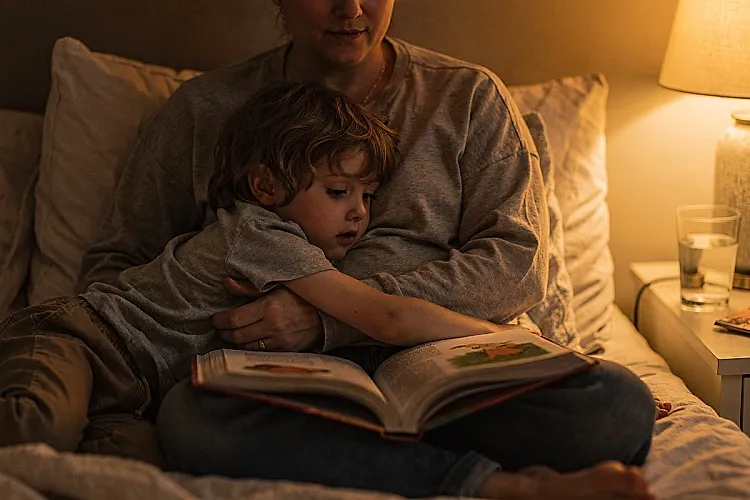
You are physically close and undistracted. No phones buzzing, no siblings interrupting, no dinner to manage. Bedtime reading is the last unbroken moment of attention most families share each day. The story is the vehicle. The closeness is the point. You can feel it: the weight of a small body against yours, the turning of a page, the specific quiet that settles over a room when a story is working.
The routine itself becomes a sleep signal. A child who hears a story every night at the same time, in the same place, develops a physiological association: book comes out, body winds down. This is more powerful than any individual story. It's the consistency of the ritual that tells the nervous system sleep is coming, and it works whether the story is two pages or twenty.
"Reading together with young children weaves joyful language and rich interactive moments into the fabric of daily life."
That's a clinical observation from the pediatrician who wrote the guidelines, and it describes exactly what happens in the story window. Language, interaction, and joy arriving together in the same five minutes. No other daily routine delivers all three.
We call this convergence the story window: the 5-15 minute period when your child is tired enough to be receptive but alert enough to process what they're hearing. Every parent knows when it opens, even if they've never named it. You can see it in the body language: the leaning in, the quieting, the eyes that are tracking the page instead of the room. Read before the window opens and the story competes with leftover energy. Read after it closes and you're narrating to someone who left five minutes ago.
The window is real. And everything in this guide is designed to help you use it.
What Your Child Needs from a Story Changes Every Year
If you've ever had the feeling that bedtime reading used to work and now it doesn't, that the books your child loved three months ago suddenly aren't landing, you're not imagining it. And you're not doing anything wrong.
What happened is simple: your child's brain grew, and it needs a different kind of story now. Your child simply moved past them. This happens to every family, and nobody warns you it's coming.
Here's what changes at each stage, and where to go deeper:
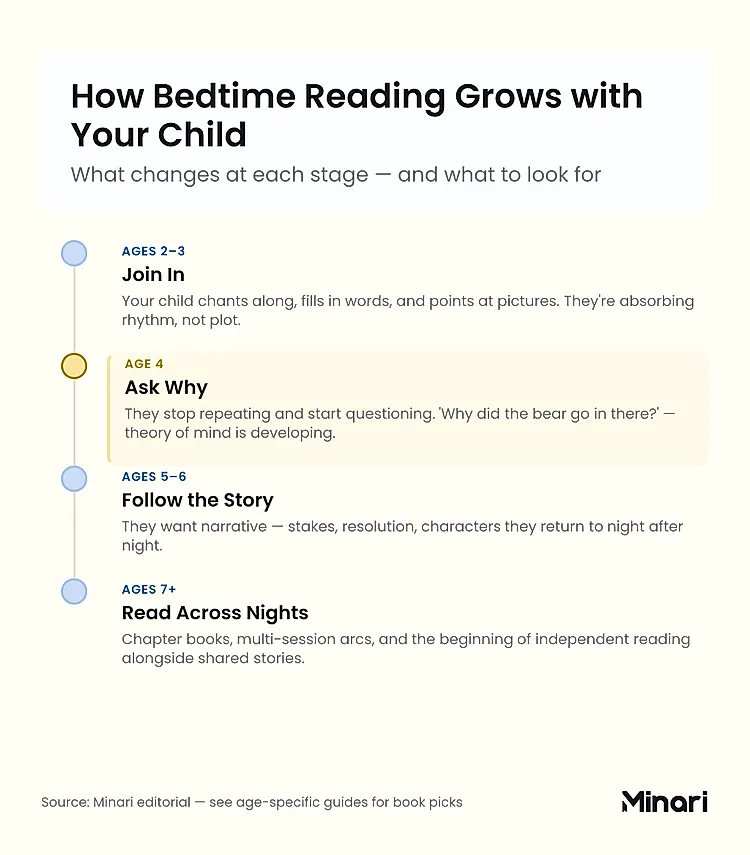
Ages 2-3: Pattern, rhythm, participation. Your toddler is absorbing sound patterns rather than following a plot, and waiting for the moment they can join in. The books that work at this age (and our toddler books guide covers the full range beyond bedtime) have what we call echo pages: the moment where your child chants the next word before you say it. That's not a distraction. That's comprehension being built in real time.
→ The full guide to bedtime stories for 3-year-olds: what echo pages are, which books have them, and how to choose stories that match how toddlers actually listen.
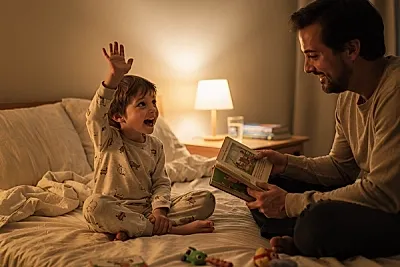
Age 4: Cause, effect, and "why?" Something shifts around four. You're reading the same book you've read fifty times, and instead of chanting along, your child holds up a hand. "But why is the bear going in there?" You pause. That question — that specific interruption — is the sound of theory of mind developing. Your child just realized the bear has reasons. Books need to match this shift, or they lose their grip.
→ The full guide to bedtime stories for 4-year-olds: the developmental shift, what "why pages" are, and the books that keep 4-year-olds engaged instead of fidgeting.
Ages 5-7: Narrative, loyalty, and what-happens-next. By five, your child wants story — real story, with stakes and resolution. They develop favorites they return to obsessively. They remember characters between readings. This is when bedtime stories for kids become bedtime stories for readers.
→ The full guide to bedtime stories for 5-year-olds: narrative comprehension at this age, the books that build it, and when to introduce chapter books read across multiple nights.
If your child is between ages (say, a mature 3 or a young 5), trust their behavior over their birthday. A child who's still happily echoing isn't ready for plot. A child who's asking "why?" has already moved on, even if they just turned three.
The Bedtime Stack — A Framework That Grows with Your Child
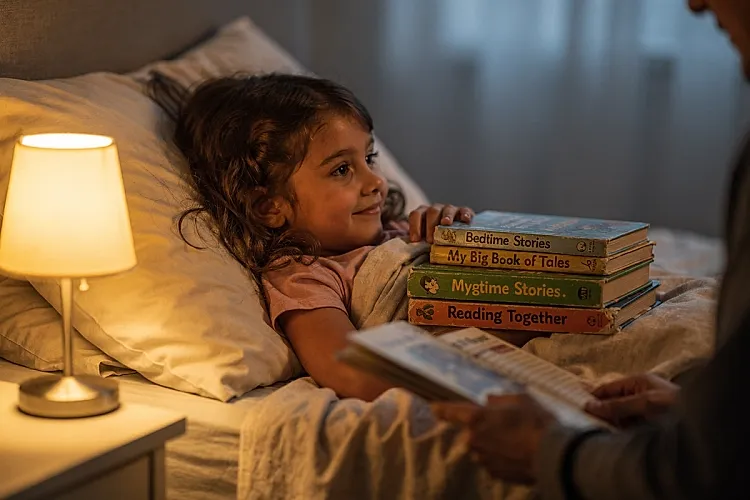
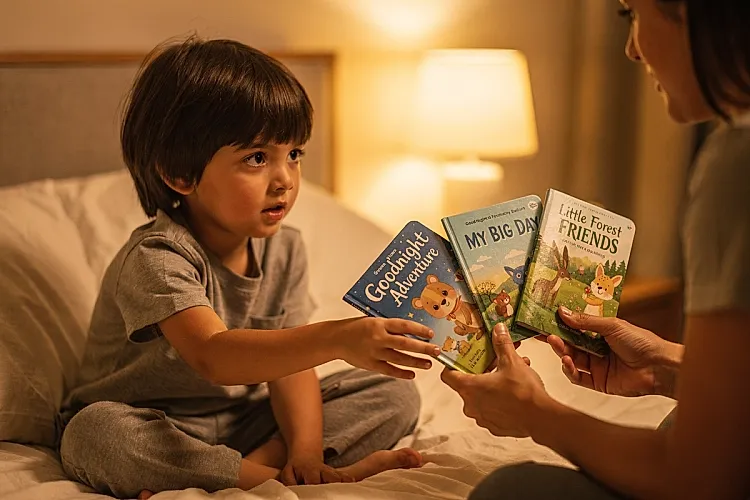
Instead of approaching bedtime with the question "What book should I read tonight?" (a question that leads to the 15-minute shelf-browsing spiral), try building the bedtime stack: a curated rotation of three to five books that you refresh as your child grows.
Every stack has three roles:
The anchor. One book your child knows by heart. It might bore you. It doesn't bore them. At age three, repetition is how language patterns cement. At four, re-reading lets them notice new details: a character's expression, a word they didn't catch the first time. At five, the anchor is a victory lap: proof they can "read" the whole thing. The anchor stays until your child stops reaching for it.
The explorer. One book that's new — something you're testing. Maybe it's a library pickup, a recommendation from another parent, or something you grabbed because the cover looked interesting. The explorer might work or it might not. That's fine. The point is to keep the rotation from going stale. If the explorer lands, it eventually becomes next week's anchor.
The wildcard. Their pick. Not from the full shelf, but from the stack. You curate the options, they choose which one tonight. This gives your child genuine autonomy (which they need, developmentally, at every age) without the decision paralysis of unlimited choice.
The same board book has been the anchor for three weeks now. The cover is soft from handling, one corner bent where it got shoved under a pillow. You could recite it from memory. But tonight your child stops you on the page with the owl, the page you've read forty times, and says, "The owl is sad because his friends are sleeping." She's never said that before. The book didn't change. She did.
The stack changes every few weeks. When a book stops getting picked, it rotates out. When your child outgrows a format (board books giving way to picture books, picture books giving way to early chapter books), the whole stack levels up.
You don't need to overthink this. You need three books and a willingness to swap one out when it stops working.
Together, these three ideas form the whole system: the story window tells you when to read, the age stages tell you what to read, and the bedtime stack tells you how to organize it. That's the framework. Everything else is refinement.
If you want a ready-made explorer set to start building your stack, we put together a week of illustrated bedtime stories — one delivered to your inbox each evening, matched to how kids at each stage listen.
Let us handle bedtime for you. 7 stories. 7 nights. Free.
One illustrated story in your inbox each evening — plus a Wonder Question to spark the kind of conversation that only happens at bedtime.
No spam. One story per night for 7 nights.
How Long Should You Actually Read?
Here's the counterintuitive finding that changes everything about this question: frequency beats duration, every time. A short bedtime story for kids read every night compounds into far more word exposure, emotional connection, and routine strength than a long session a few times a week. The parent who reads one board book every single night is doing more than the parent who reads for 30 minutes on weekends.
Which means the answer to "how long" is however long you can do every night. For most families, that looks like 2-4 minutes at age 2-3, 5-10 minutes at age 4, and 10-15 minutes by ages 5-7. But the number matters less than the streak.
If time is tight, lean short. We wrote a full guide to 5-minute bedtime stories that covers why the short format works and how to make five minutes feel complete. And if you're looking for the best short bedtime stories for kids, we break down what makes a short story land, including how to find the one moment where the emotional payload arrives and your child goes quiet.
What to Do When Bedtime Reading Stops Working
Every family hits a phase where the routine breaks. The child resists, the parent is exhausted, the books feel stale. This doesn't mean bedtime reading failed. It means something changed, and the routine needs to catch up.
If your child suddenly resists stories they used to love: the books don't match their stage anymore. A 4-year-old pushing away board books is rejecting stories that no longer challenge them. Refresh the stack. Move up one level in complexity.
If your child won't sit still: Stop measuring engagement by stillness. At three, a child pointing at pictures and squirming IS engaged. At four, a child interrupting with questions IS engaged. At five, a child predicting what happens next IS engaged. Stillness is an adult metric for a child-sized experience.
If you're too tired to read: Read anyway. Read badly. You're three pages into Goodnight Moon and your own eyes are closing. Your child hasn't noticed — they're watching the page, not your performance. You mumble "goodnight stars" and they whisper it back. That's enough. That's the whole thing working. A parent who yawns through a board book is doing more for their child's development than a parent who skips the story because they can't perform it well.
If you missed a week — or a month: Start tonight. There's no reset penalty. The neural pathways don't care about your streak. They care about the next page.
The routine bends. It doesn't break. And the child who had stories read to them — imperfectly, inconsistently, by a parent who was learning as they went — carries something no amount of screen time can replicate: the memory of being held, and heard, and read to.
Frequently Asked Questions
Tonight, somewhere, a parent will pick up a book and read for five minutes. They'll worry it isn't enough. It is. Those five minutes, multiplied by every night this year, will deposit hundreds of thousands of words into a mind that's built to absorb them.
Every page tonight is a deposit. And the account never closes.