Why Your 4-Year-Old Suddenly Won't Just Listen to the Story
Four-year-olds don't outgrow bedtime stories. They outgrow passively listening. Here's what changed, what to read now, and how to make the why-questions work for you.

Minari Editor
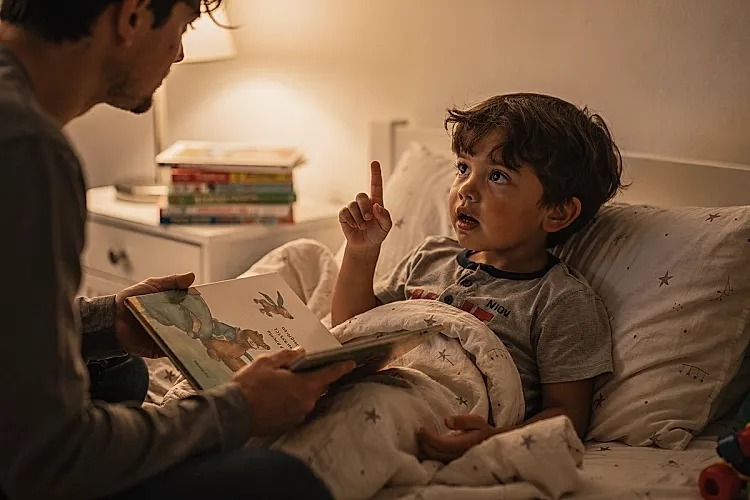
You're two pages into the same book you've read a hundred times, and your 4-year-old holds up a hand. Not to repeat a word — that was last year. This time it's a question.
"But why is the bear going in there?"
You pause. At three, this child chanted along with every rhyme. Now they want to know what the bear is thinking. What changed?
Everything, actually. And it's the best thing that could happen to your bedtime reading routine.
What Changes in How 4-Year-Olds Listen to Stories

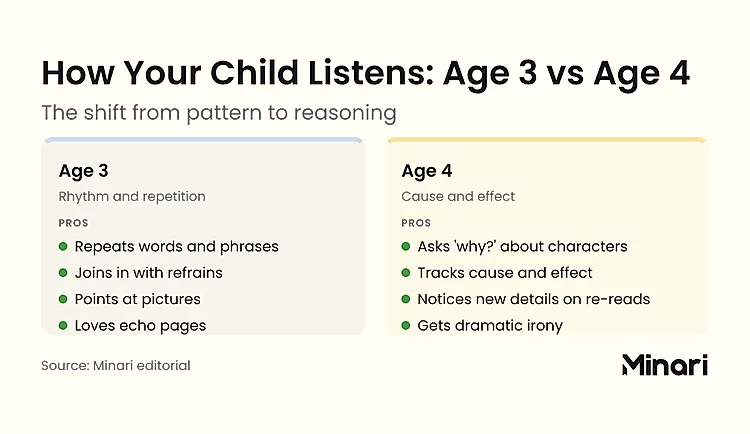
If you're noticing a shift from how bedtime stories for 3-4 year olds used to work (the chanting, the pointing, the happy repetition), your child's brain developed a new skill: theory of mind.
Around age 4, children begin understanding that other people (and characters) have thoughts, feelings, and motivations different from their own. Research compiled by developmental psychologists at the University of Toronto in the Encyclopedia on Early Childhood Development confirms that a crucial shift typically occurs around age 4, when children first recognize that a character's beliefs can differ from reality, fundamentally changing how they engage with narrative.
This means your child is now tracking intentions, not just hearing words. When they ask "why is the bear going in there?" they're doing something remarkable — they're reasoning about a fictional character's mind.
Watch for what we call the why page: the moment in a story where your 4-year-old stops and asks why a character did something. Books with strong why-pages (clear character motivations, small dilemmas, cause-and-effect surprises) keep 4-year-olds engaged. Books without them? Those get the hand-up-and-away treatment two pages in.
The bedtime stories that worked at three were built on rhythm and repetition. At four, your child needs stories built on reason. Not complex plots — just enough "why" to chew on.
How Long Should Bedtime Stories Be for a 4-Year-Old?
For quick bedtime stories for 4 year olds, aim for 5-10 minutes of reading time. That's longer than the 2-4 minute board books of age three, but shorter than the chapter-book sessions that work for school-age kids.
Here's what's different at four: your child may start asking for "one more page." They genuinely want to know what happens next. That's narrative drive kicking in, and it's a developmental milestone worth celebrating (even at 8:15 PM).
A practical approach that works for many families: the anchor-plus-explorer method. Read one short, familiar book (the anchor, 2-3 minutes) followed by one slightly longer new book (the explorer, 5-7 minutes). The anchor satisfies the need for comfort and predictability. The explorer feeds the growing appetite for plot.
You don't need to find seven new explorer books to try this. We put together a set built for exactly this stage: one illustrated bedtime story in your inbox each evening for a week, matched to how 4-year-olds listen now.
Let us handle bedtime for you. 7 stories. 7 nights. Free.
One illustrated story in your inbox each evening — plus a Wonder Question to spark the kind of conversation that only happens at bedtime.
No spam. One story per night for 7 nights.
If time is tight, a single 5-minute bedtime story with a clear beginning, middle, and end works better at this age than two ultra-short board books. Four-year-olds want to arrive somewhere in the story. They want a resolution, however simple.
The attention-span research supports this window. While individual children vary, most 4-year-olds sustain focused attention for roughly 8-12 minutes in low-stimulation settings like bedtime, consistent with the widely cited developmental benchmark of two to three minutes per year of age.
What Kind of Stories Do 4-Year-Olds Love?

This is the age of the plot bridge — stories that bridge between the pattern-based reading your child loved at three and the narrative-driven reading they'll grow into at five. Plot bridge books have simple cause-and-effect (this happened, so that happened) with enough surprise to trigger why-questions.
Three categories of best bedtime stories for 4 year olds that consistently work:
Stories with surprise endings. Four-year-olds are developing a sense of humor rooted in expectation violations — things that aren't what they seem. Knuffle Bunny by Mo Willems works beautifully because the child knows something the parent character doesn't. That dramatic irony? Your 4-year-old gets it now. They didn't at three.
Stories where characters solve problems. Rosie Revere, Engineer by Andrea Beaty gives children a protagonist who fails, adapts, and tries again — a narrative structure that mirrors how 4-year-olds are learning to handle frustration in real life. The why-page here is powerful: "Why did she keep building after it broke?"
Stories with gentle tension that resolves. The Darkest Dark by astronaut Chris Hadfield tells the story of a boy afraid of the dark who watches the moon landing and reframes his fear as wonder. Four-year-olds are developing the emotional vocabulary to sit with mild tension — as long as they know it resolves. This book does that perfectly.
A few more that belong on your shelf: The Very Hungry Caterpillar by Eric Carle (the transformation gives 4-year-olds a satisfying "that's why"), Curious George by H.A. Rey (consequence-based plots that trigger great why-questions), and After the Fall by Dan Santat — a picture book about getting back up after a fall that works on levels your child will understand now and differently at six. For beyond-bedtime reading at this age, our best books for 4-year-olds rounds out the shelf.
How to Make Bedtime Reading Stick at Age 4
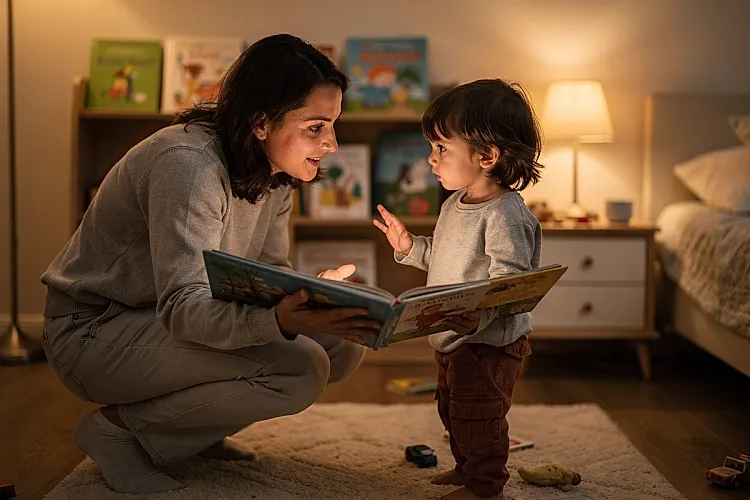
The two-choice method. Don't hand your 4-year-old the entire bookshelf — that's overwhelming and leads to the 15-minute browsing session that eats into actual reading time. Instead, pull two or three books and say "which one tonight?" You curate, they choose. Autonomy without chaos.
Embrace the "why?" When your child interrupts with a question, resist the urge to say "let's keep reading." Pause. Answer briefly; even "what do YOU think?" works. Then continue. These micro-conversations are where comprehension gets built. A 2020 meta-analysis in *Child Development* reviewing 19 randomized controlled trials found that interactive shared reading, where caregivers engage with children's questions and comments during storytime, produced significantly stronger expressive and receptive language outcomes than passive read-alouds.
Balance re-reads with new material. At four, your child still wants familiar books — but now for different reasons than at three. At three, repetition was about pattern mastery. At four, re-reading is about noticing new details. They'll spot things in the illustrations they missed before. They'll ask different why-questions on the fifth read than they did on the first. Let them re-read, but keep introducing one new book per week to expand the rotation.
Looking ahead, bedtime stories for 5-year-olds shift toward longer narratives and early chapter books, but at four, picture books with strong plot bridges are exactly where your child needs to be.
Frequently Asked Questions
Tonight, when your 4-year-old holds up a hand and asks why the bear is going in there — that's not an interruption. That's your child stepping inside the story for the first time, looking around, and trying to figure out how the world works.
The bear doesn't mind waiting.