The Best First Day of School Books for Kindergarten
The best first day of school books for kindergarten, matched to the worry each one calms, plus when to read them so they actually help on the big morning.

Minari Editor
At home, your child is the main character. Every story you tell is, in some quiet way, about them. Then one morning in late summer they walk through a classroom door, a grown-up they have never met picks up a list, and starts reading names out loud. Yours is somewhere on it.
That is the leap the first day of school asks a five-year-old to make: from known to one of twenty-five. It is not really an academic leap. It is the moment a child learns they can be a whole person in a room where nobody knows them yet. The best first day of school books exist to rehearse that leap before your child has to take it for real. The strongest picks for kindergarten, listed below, each answer a different first-day worry, and that is exactly how you should choose between them.
What first day of school books actually do
A child psychologist will tell you that the scariest thing about a new experience is its newness, the sheer not-knowing of it. This is what the best books about first day of school worries quietly do: they take that newness apart in advance. When a child meets a character who is nervous about the bus, walks into the classroom, finds a place to sit, and comes home fine, they have lived the whole arc once already, safely, from your lap. Bibliotherapy, the practice of using stories to help children process difficult feelings, is built on exactly this idea, and it is why teachers and pediatricians so often suggest reading about a big change before it arrives.
There is a particular instant these books are quietly preparing your child for. Call it the roll-call moment: the first time a child hears their own name read aloud in a room full of strangers and becomes a person there, not a visitor. The whole first day turns on that hinge. A good book lets your child stand at that hinge with a character first, so the real version feels less like a cliff and more like something they have done before.
This is also why a book beats a pep talk. A pep talk asks your child to manage a feeling they cannot yet name. A story hands the feeling to someone else, the worried penguin or the brand-new kid, and gives your child the language to point at it: that's me, I feel like that. And unlike a conversation, a book can be read again, which is the part that actually matters.
The best first day of school books for kindergarten
These are the starting kindergarten books to read aloud in the run-up to the first day. They are organized by the worry each one answers, because the right pick depends less on your child's age than on what is keeping them up at night.
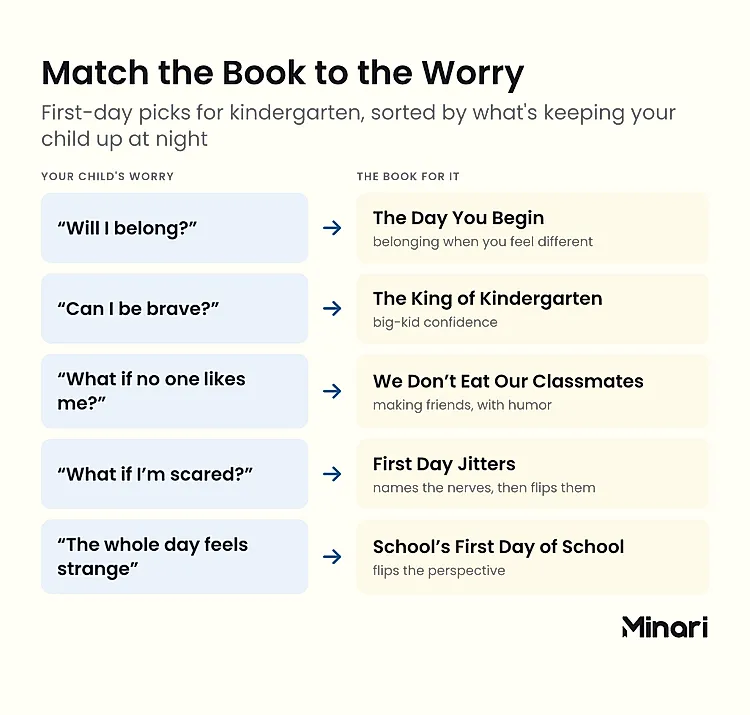
"Will I belong?" → *[The Day You Begin](https://bookshop.org/p/books/the-day-you-begin-jacqueline-woodson/11325085?ean=9780399246531)* by Jacqueline Woodson. Woodson writes for the child who looks around the room and feels like the only one who is different, whether because of language, lunch, or the summer everyone else seemed to have. It is the most beautiful book on this list, and the one to reach for if your child's worry is less about logistics and more about fitting in.
"Can I be brave?" → *[The King of Kindergarten](https://bookshop.org/p/books/the-king-of-kindergarten-derrick-barnes/ad1a7bd78dcea67f)* by Derrick Barnes. A small boy is sent off with the message that he is going to rule his first day, and the whole morning becomes a hero's journey, from brushing his teeth to riding the bus to raising his hand. It is pure confidence in book form, and a wonderful counterweight if your child needs to feel big rather than reassured.
"What if no one likes me?" → *[We Don't Eat Our Classmates](https://bookshop.org/books/we-don-t-eat-our-classmates/9781368003551)* by Ryan T. Higgins. Penelope is a T. rex starting school, and her classmates are, inconveniently, delicious. The book is laugh-out-loud funny, and that is the point: it takes the most loaded fear of the first day, making friends, and defuses it with a dinosaur. Laughter is its own kind of reassurance.
"What if I'm scared?" → *[First Day Jitters](https://bookshop.org/p/books/first-day-jitters-julie-danneberg/286329)* by Julie Danneberg. Sarah refuses to get out of bed, dreading her first day, and the ending delivers a twist worth waiting for: Sarah is the teacher. Children love being in on the secret, and the message lands without a lecture, namely that everyone, even the grown-ups, feels the jitters.
"The whole day feels strange" → *[School's First Day of School](https://bookshop.org/books/school-s-first-day-of-school-9781596439641/9781596439641)* by Adam Rex. Here the school building itself is the nervous one, worried the children won't like it. Flipping the perspective gives your child the comforting role of the calm one, and it gently reframes the whole institution as something with feelings rather than a place that swallows you whole.
A quick note on age: if you want a wider net of read-aloud favorites for a new kindergartner beyond the first-day theme, our list of the best books for 5 year olds covers the broader shelf, and our guide to the toddler reading arc maps how books change all the way up to five.
You don't have to find seven different books to make this work. The rehearsal happens through repetition, not variety, so one or two of these, read several nights running, will do more than a whole stack read once. If you want a calm nightly ritual to build around in the week before school starts, our free seven-night story collection sends one illustrated bedtime story to your inbox each evening. Use it as the steady anchor each night, with your chosen first-day book as the centerpiece.
Let us handle bedtime for you. 7 stories. 7 nights. Free.
One illustrated story in your inbox each evening — plus a Wonder Question to spark the kind of conversation that only happens at bedtime.
No spam. One story per night for 7 nights.
Starting at a brand-new school, not kindergarten?
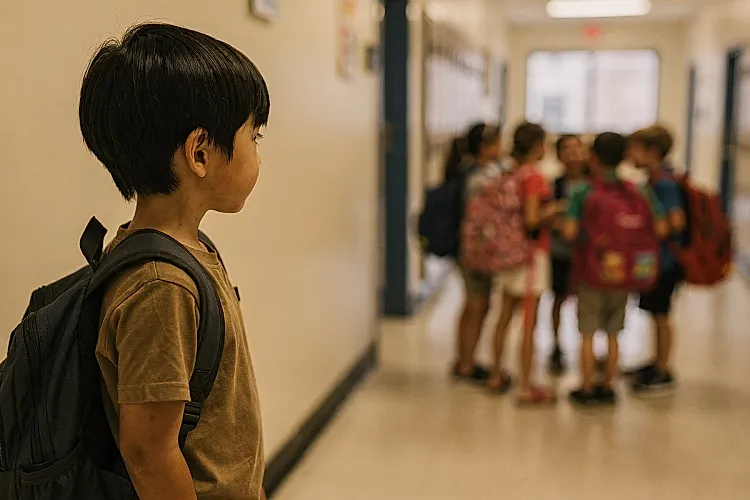
The same leap shows up again for an older child changing schools in first or second grade, just with a child who knows the routine and only the faces have changed. Most of the worry is about belonging all over again. The Day You Begin carries beautifully up to this age and is worth re-reading even if your child met it before kindergarten. Pair it with Strictly No Elephants by Lisa Mantchev, a quiet gem about a boy and his tiny pet elephant who are turned away from the pet club and decide to build their own, a small, perfect story about finding your people when the existing group has no room for you. For a child walking into an established class where everyone already has a best friend, that is the exact fear, named and answered.
How to read them so they actually help
The single most useful thing to know is this: read the book the week before, not the morning of. Reading a first-day book for the first time over a rushed breakfast on the actual day tends to raise the temperature rather than lower it. Treat it instead as the rehearsal read, a story you return to over several calm nights in the run-up, so that by the time the morning arrives the day feels remembered rather than brand new.
A few things make the rehearsal land. Re-read on request, even if it is the fourth night in a row, because the repetition is the preparation. Let your child narrate the character's worry back to you instead of explaining it for them. Resist the urge to turn the story into a lesson; the book is already doing the work, and a tacked-on talk can undo it. You will feel your own version of this leap that morning, watching a door close on a room you cannot follow them into, and that ache is allowed. Keep your goodbye short and certain anyway, since a long one reads to your child as a reason to be afraid. If the big feelings surface again at bedtime, as they often do, our collection of bedtime stories about feelings is built for exactly that quieter hour.