The Bedtime Stories That Help Kids Feel What They Can't Say
When a hard day's feelings surface at bedtime, the right story gives them a name. Here's how emotional bedtime stories work, which ones to keep on the shelf, and what to do when tears come mid-page.

Minari Editor

Your child had a hard day. You could see it at dinner. The short answers, the look that meant something happened but couldn't be said. Now it's bedtime, the room is quiet, and the feeling that's been waiting all afternoon finally arrives.
This is not a problem. This is the moment the feeling has been waiting for.
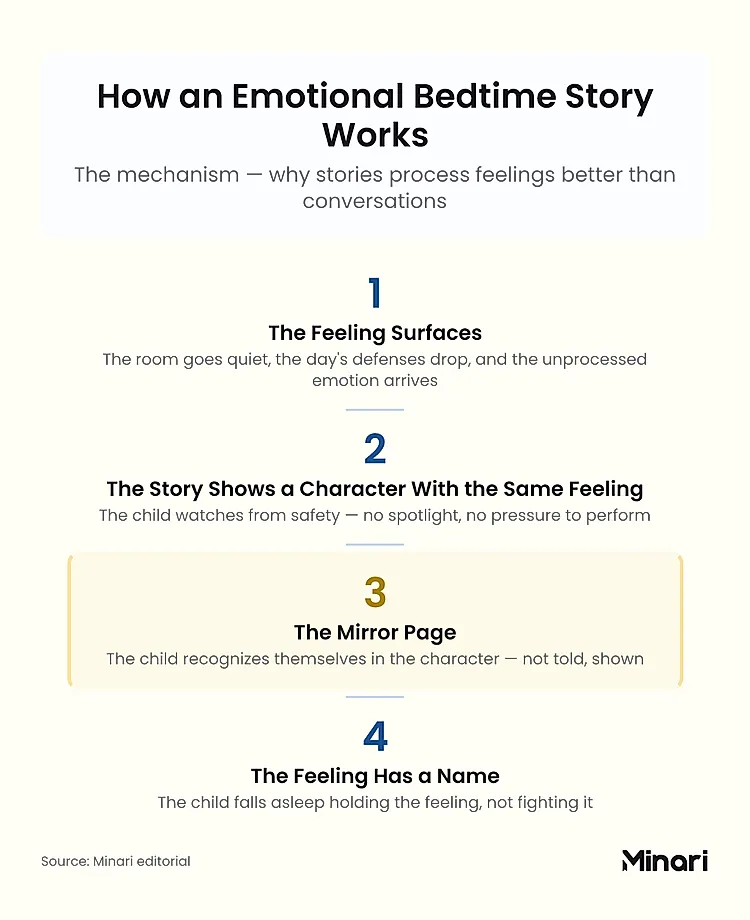
Children don't process emotions in real time. They store them — in their bodies, in their behavior, in the silence between sentences — and the feelings surface when the noise of the day finally stops. That's why bedtime, of all times, is when the tears come, the fears appear, and the thing that happened at recess suddenly matters more than it did six hours ago.
The right bedtime story at this moment does something no conversation can: it gives the feeling a name without making your child the subject.
Why Feelings Surface at Bedtime

The bedroom at 8 PM is the quietest environment your child encounters all day. No classmates, no screens, no structured activities demanding attention. In that quiet, the brain shifts from doing to processing — and everything that was held at bay during the day comes forward.
This is why your child is fine all afternoon and then suddenly can't stop talking about something that happened at lunch. Or why a fear that seemed manageable at 4 PM becomes overwhelming at 8 PM. The story window, that period when a child is tired enough to be receptive but alert enough to process, is also the emotional processing window. The same conditions that make bedtime ideal for absorbing a story make it ideal for surfacing a feeling.
A 2016 study in *Infancy* found that toddlers who participated in shared story reading with guided conversations about emotions significantly outperformed peers in a control group on measures of emotion understanding. The researchers noted that discussing characters' feelings during reading gives children a way to process emotional experience indirectly, through a character's situation rather than their own, which reduces defensiveness and allows deeper engagement.
This means the emotional bedtime stories for kids that actually work are the ones that let children feel: safely, indirectly, at one remove from their own experience.
How Stories Help Children Name What They Feel
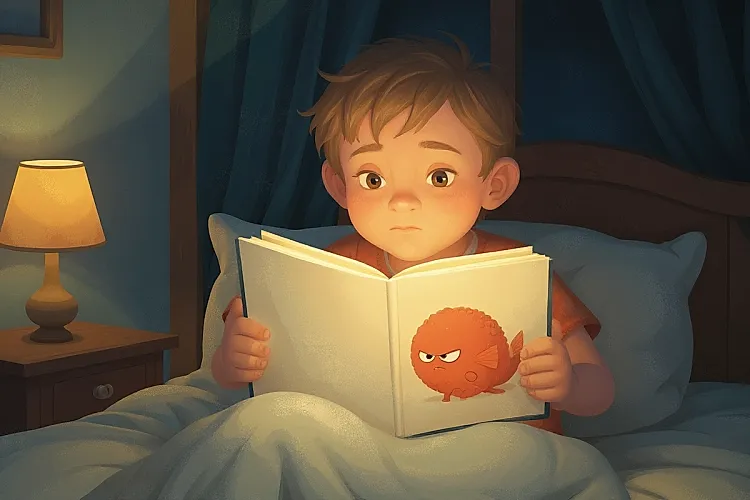
Here's the mechanism: a child who is angry doesn't know they're angry. They know their face is hot, their fists are tight, and everything feels unfair. They don't have the word yet. A story gives them the word by showing them a character who has the same hot face and tight fists — and then names it.
We call this the mirror page: the moment in an emotional bedtime story where a child sees their own feeling reflected in a character's experience. Not stated as a lesson. Not announced with "can you see how the bear is feeling?" Shown through the character's body language, their expression, the way the story slows down on that page.
The difference between a story that teaches about feelings and a story with a mirror page is the difference between being told what to feel and recognizing what you already feel. Teaching about feelings reads like a worksheet. The mirror page delivers a revelation.
This is why calming bedtime stories for kids work better than conversations about emotions at this hour. A parent asking "what's wrong?" puts the child in the spotlight. A story puts a character in the spotlight — and the child watches from the safety of their bed, leaning into your side, identifying with the character at their own pace. No performance required.
At ages 2-3, this works through echo pages. The child absorbs the emotional rhythm before they understand the content. At age 4, the why page extends to emotions: "Why is the bear sad?" means the child is reasoning about emotional states, not just experiencing them.
If you want stories that meet your child at this stage, one each evening for a week, matched to how children listen, we put together a set of illustrated bedtime stories delivered to your inbox.
Let us handle bedtime for you. 7 stories. 7 nights. Free.
One illustrated story in your inbox each evening — plus a Wonder Question to spark the kind of conversation that only happens at bedtime.
No spam. One story per night for 7 nights.
Building the Feeling Shelf: Stories for Every Hard Night
Instead of searching for the right book in the moment (when your child is already upset and bedtime is already late), build what we call the feeling shelf: a small curated collection organized not by age or genre, but by emotion. Four or five books, each one matched to a specific kind of hard night, so the right story is always within reach.
For anger and frustration: Alexander and the Terrible, Horrible, No Good, Very Bad Day by Judith Viorst. The mirror page: Alexander's bad day unfolds as a cascade of small disasters, not one big one. Your child sees that bad days are allowed, and they end. The pacing matches how frustration actually feels: relentless, cumulative, and eventually exhausting enough to surrender.
For sadness and loss: When Sadness Is at Your Door by Eva Eland. Sadness arrives as a visitor — a quiet, pale teal figure that follows the child around. The mirror page: instead of fighting sadness or fixing it, the child learns to sit with it. This is one of the few children's books that treats sadness as a temporary companion rather than a problem to solve.
For anxiety and worry: Ruby Finds a Worry by Tom Percival. Ruby's worry starts small and grows until it blocks everything. The mirror page: when Ruby finally talks about it, the worry shrinks. Your child learns that naming the worry is the mechanism for reducing it, not a platitude but a cognitive truth that therapists call externalization.
For separation anxiety and being apart: The Invisible String by Patrice Karst. A string connects people who love each other, even when they're apart. The mirror page: the child tugs the string and feels the tug back. For bedtime separation anxiety specifically, this book gives the child a physical metaphor they can hold onto after you leave the room.
For naming emotions when words aren't enough: The Color Monster by Anna Llenas. Each feeling gets a color and a jar. The monster sorts the tangled mess of emotions into individual, manageable containers. The mirror page: the child realizes feelings can be separated, identified, and contained. This is emotional vocabulary building in its most visual form.
For body-based emotional awareness: Listening to My Body by Gabi Garcia. Connects physical sensations (butterflies in stomach, tight shoulders, racing heart) to emotional states. The mirror page: your child learns to read their own body as a map of feelings, which is the foundation of self-regulation.
What to Do (and Not Do) When Feelings Come Up Mid-Story

Don't force the conversation. The biggest mistake parents make with emotional bedtime stories is trying to turn them into therapy sessions. "Do you feel like the bear feels?" puts your child on the spot. The story is already doing the work. Your job is to read it, stay close, and trust the mirror page.
Use the pause. If your child goes quiet on a page — really quiet, not distracted-quiet — stay there. Don't turn the page. Don't ask what they're thinking. Just wait. That silence is the feeling being processed. It might last three seconds or thirty. Both are fine.
Validate without analyzing. After the story, if your child seems moved, a simple "that was a big one" is enough. You're acknowledging the experience without dissecting it. You're not a therapist. You're a parent who sat close and read a story that mattered tonight.
Know when NOT to read an emotional story. If your child is already dysregulated (sobbing, screaming, physically agitated), this is not the moment for a feelings book. Read a calming story first. Something rhythmic, familiar, physically soothing. Goodnight Moon. An old favorite from the shelf. The emotional story works best when the child is in the window, receptive but not overwhelmed. Save the feelings book for tomorrow night, when the feeling is still there but the volume has come down.
Frequently Asked Questions
Tonight, when the feeling arrives — the one that's been waiting since this afternoon, the one your child couldn't say at dinner — reach for the right book. Not to fix the feeling. Not to explain it away. Just to keep it company for five pages while your child falls asleep.
The feeling doesn't need to be solved. It needs a story. And a parent who stayed.