The Best Halloween Books for Toddlers (Spooky Enough to Be Fun, Not Scary)
The best halloween books for toddlers: silly monsters, friendly ghosts, and pumpkin stories chosen for the sweet spot between festive and frightening.

Minari Editor
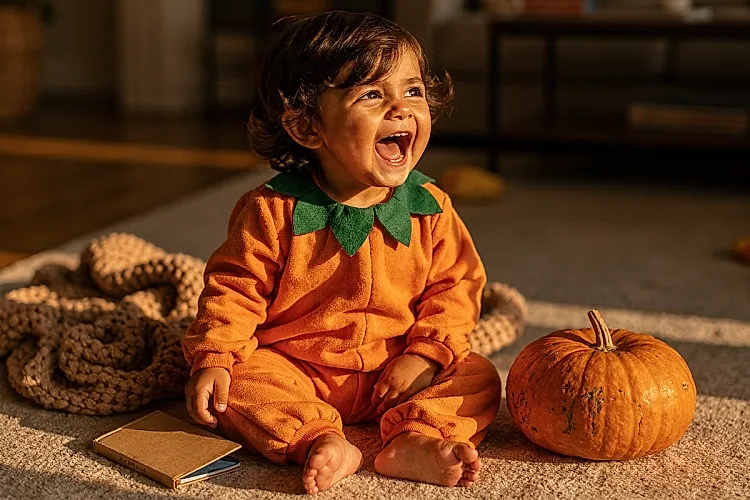
Your toddler will happily wear a skeleton costume and dance around the living room. Show them a picture of an actual skeleton in a book and they'll scream.
Same concept. Completely different reaction. And the difference tells you everything you need to know about choosing halloween books for toddlers (or any toddler book, really): the costume is funny and familiar. The picture is strange and real. The books that work at this age live entirely on the costume side of that line — atmospheric enough to feel like Halloween, silly enough to feel safe.
Here are seven that get it right, plus how to tell whether a Halloween book belongs in your toddler's October stack or back on the shelf.
What Makes a Halloween Book Work for a Toddler?
The line between "fun spooky" and "actually scary" is narrower than most adults realize, and it shifts by the month at this age.
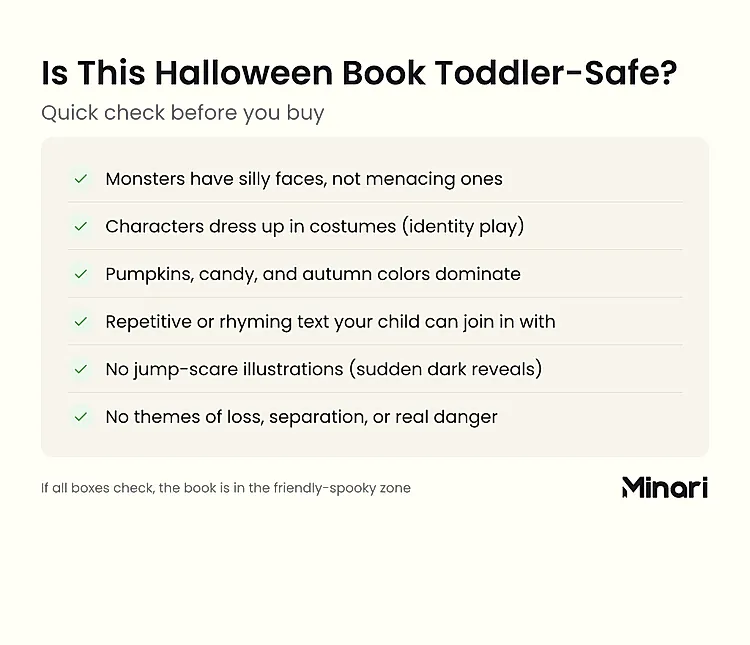
We'd call the sweet spot the friendly spooky. A Halloween book hits the friendly spooky when it delivers atmosphere (orange and black, pumpkins, costumes, moonlight, maybe a silly ghost) without any moment that makes your toddler's face change from delighted to distressed. The friendly spooky is a feeling: Halloween-ish, but warm. Festive, not frightening.
Why do toddlers love Halloween themes at all? Three reasons, and none of them are about being scared:
Costumes are identity play. When a character puts on a costume, your toddler is watching transformation: this is a cat, but now it's a witch-cat. That shift is developmentally fascinating at ages 1-3, when children are just beginning to understand that things (and people) can be two things at once. We'd call the page where characters dress up the costume page, and it's the most powerful page in any toddler Halloween book. The thrill is in becoming someone else.

Silly monsters are safe boundary-testing. A toddler who giggles at a googly-eyed monster is practicing something important: encountering the unfamiliar and deciding it's okay. The silliness is the safety net. When the monster has a big goofy smile and a name like "Boo-Boo," your toddler can rehearse the experience of meeting something strange without any real threat.
Pumpkins are familiar objects made special. A pumpkin is just a pumpkin — until it has a face. That transformation (ordinary → extraordinary) maps directly to how toddlers experience the world: everything is still new enough to become magical with one small change.
What crosses the line? Jump-scare illustrations (a character suddenly appears from behind a dark page), genuinely menacing facial expressions, themes of loss or separation, and anything with realistic darkness (not illustrated darkness, but the kind that makes a room feel unsafe). A toddler who "hides" behind the book when the silly ghost appears, then peeks out laughing? That's the friendly spooky working. A toddler who pushes the book away and won't look at it? That book crossed the line.
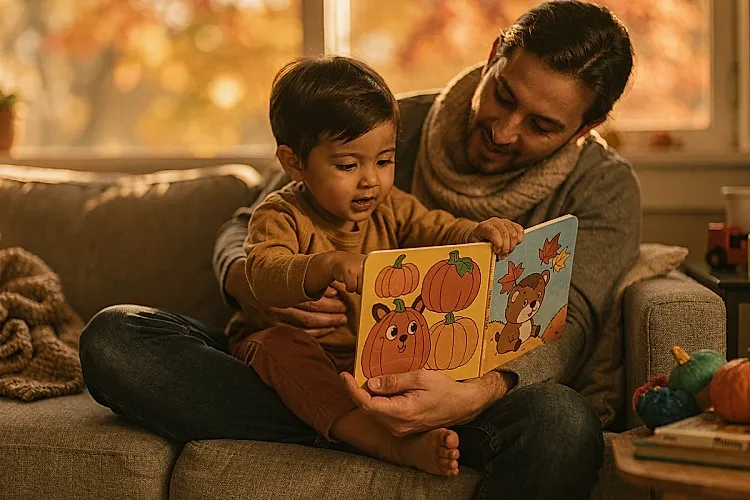
7 Halloween Books for Toddlers That Hit the Sweet Spot
Every pick on this list lands firmly inside the friendly spooky zone. If you're buying for a toddler you don't know well, any of these are safe.
Room on the Broom by Julia Donaldson, illustrated by Axel Scheffler
The household name for a reason. A witch picks up passengers (a cat, a dog, a bird, a frog) on her broom until it snaps — and then they all save her from a dragon by pretending to be a monster. The rhyming text is pure toddler fuel, the "monster" is clearly just the friends stacked on top of each other, and the moral (friendship beats fear) lands without a lecture. This is the Halloween book that stays in rotation year-round. Find it on Bookshop.org
Go Away, Big Green Monster! by Ed Emberley
The empowerment book. Each page adds a feature to a monster's face (yellow eyes, a big red mouth, scraggly purple hair) and then the child gets to make each feature GO AWAY, page by page, until the monster is gone. The brilliance: the child controls the scary thing. They build it and then they dismantle it. For toddlers who are just learning that they have agency over their world, this is as satisfying as it gets. Find it on Bookshop.org
Click, Clack, Boo! by Doreen Cronin, illustrated by Betsy Lewin
The farm animals from Click, Clack, Moo put on a Halloween party. The barn is "dark" and "scary" (it isn't; the illustrations are bright and goofy) and the animals are in costume. The humor works because the animals take Halloween seriously while clearly having no idea what they're doing. Toddlers love the repetitive sound effects, and the "boo!" moments are telegraphed so far in advance that even the most cautious child knows they're coming. Find it on Bookshop.org
The Little Old Lady Who Was Not Afraid of Anything by Linda Williams, illustrated by Megan Lloyd
A cumulative story where a little old lady meets progressively "scary" things on her walk home: shoes that go CLOMP CLOMP, pants that go WIGGLE WIGGLE, a pumpkin head that goes BOO BOO. The repetition is the game: your toddler will be making all the sounds along with you by the second read. The reveal? The pieces assemble into a friendly scarecrow. Zero actual fear, maximum participation. Find it on Bookshop.org
If you're adding Halloween stories to a reading routine this October, we put together a set of illustrated bedtime stories. One in your inbox each evening for a week. They're not Halloween-themed, but they pair well as the calming anchor after a daytime spooky story session.
Let us handle bedtime for you. 7 stories. 7 nights. Free.
One illustrated story in your inbox each evening — plus a Wonder Question to spark the kind of conversation that only happens at bedtime.
No spam. One story per night for 7 nights.
Pete the Cat: Trick or Pete by James Dean
Pete the Cat in a Halloween costume is the low-stakes seasonal book every toddler library needs. Pete heads out trick-or-treating in his costume, and lift-the-flap surprises reveal that every spooky shadow or glowing shape is actually something perfectly harmless. The illustrations are bold and simple, the text is minimal, and there's nothing remotely scary — just a blue cat having a nice Halloween. For 1-2 year olds who aren't ready for even the mildest spookiness, this is your pick. Find it on Bookshop.org
Pumpkin Soup by Helen Cooper
The sophisticated pick. Three friends (a cat, a squirrel, and a duck) make pumpkin soup together every day until the duck decides he wants to stir the pot instead of adding salt. An argument ensues. The duck leaves. The friends worry, search, and reconcile. It's not a Halloween story — but it's a pumpkin story with emotional depth that 2-3 year olds are ready for. The Kate Greenaway Medal-winning illustrations are autumnal and gorgeous. For the toddler who is ready for stories with real feelings, not just costumes. Find it on Bookshop.org
Creepy Pair of Underwear! by Aaron Reynolds, illustrated by Peter Brown
The underdog pick — and the funniest book on this list. Jasper Rabbit buys a pair of glow-in-the-dark underwear that turns out to be too creepy to keep. He throws them away. They come back. He buries them. They come back. The escalation is hilarious, and the resolution (he decides to be brave) is earned without being preachy. Best for 2.5-3+ year olds who can handle the slightly-scary-but-clearly-played-for-laughs tone. This is the spooky stories for toddlers pick that makes parents laugh as hard as kids. Find it on Bookshop.org
How to Read Halloween Books Without Creating Bedtime Monsters

The friendly spooky works best with a few guardrails, especially if you're the gift-giver and not the one doing bedtime.
Read it during the day first. Halloween books and bedtime don't always mix for toddlers. The silly ghost that was hilarious at 2 PM can become a lot less silly at 8 PM in a dark room. Introduce new Halloween books as afternoon reads, and let the child decide if they want to bring it to bedtime. The best bedtime stories for this age are familiar and calming — the opposite of new and festive.
Use silly voices for every "scary" character. The monster gets a squeaky voice. The ghost says "boo" in a whisper. The witch cackles like she's just told the funniest joke. Your voice is the safety net. It tells the child's brain "this is play, not danger." The sillier you go, the safer the book feels.
Let them close it. If your toddler pushes the book away, that's clear communication. The book crossed their friendly-spooky line. Try again in a few weeks, or try again next October. What scared them at 18 months will delight them at 24 months. The line moves fast.
Frequently Asked Questions
Come October, when your toddler reaches for the book with the pumpkin on the cover — the one where the silly ghost says "boo" and they hide behind the pages, laughing — that's not a child being scared. That's a child who has learned that the strange can be funny, that the dark can be warm, and that the thing behind the flap might be exactly what they hoped for.
And the person who brought that book? They chose well.