The Best Interactive Books for Toddlers (That Turn Fidgeting Into Reading)
The best interactive books for toddlers, including lift-the-flap, touch-and-feel, and sensory books chosen for how toddlers actually engage with stories.

Minari Editor

Last Tuesday, your toddler ripped a page out of a picture book. You taped it back and felt that familiar pang: maybe they're just not a book kid.
This morning, same child, same hands. You hand them a lift-the-flap book. They sit on the floor and carefully, deliberately lift every flap. Close the book. Open it again. Do it all over. Twenty minutes pass without a single torn page.
The difference isn't the child. It's the mechanism. Interactive books for toddlers work because they give busy hands a job — and that job, it turns out, is exactly how toddlers learn at every stage of the reading arc.
Here's what each type of interactive book actually does for your child's brain, plus seven picks that are worth the shelf space.
Why Interactive Books Work (And What They're Really Teaching)
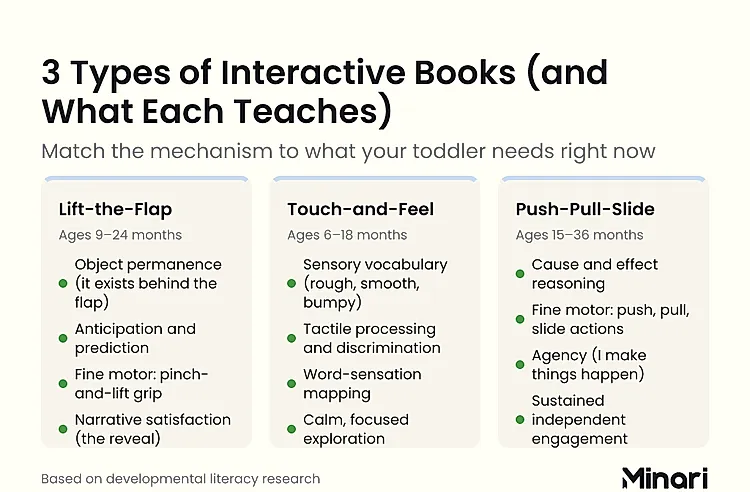
A toddler's hands are always doing something: grabbing, pulling, poking, tearing. Most parents spend reading time redirecting those hands away from the pages. Interactive books flip the equation: they give those hands a purpose.
We call this the busy hands rule. A toddler's impulse to touch and manipulate is the primary way they process information at this age. Every flap, slider, and textured patch in an interactive book turns that impulse into a learning event. When your child lifts a flap to find a hidden animal, they're practicing three things at once: fine motor control (the pinch-and-lift), anticipation (what's under there?), and object permanence (it exists even when I can't see it).
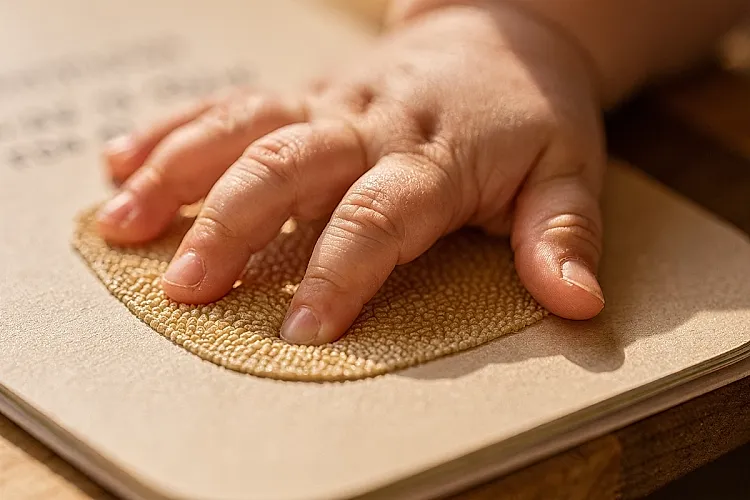
The three main types of interactive books each serve a different developmental purpose:
Lift-the-flap books teach anticipation and object permanence. The act of hiding and revealing mirrors the peek-a-boo game that toddlers are developmentally obsessed with around age 1-2. Every flap is a prediction: will the cow be behind the barn door? The answer matters less than the asking.
Touch-and-feel books (what many parents call sensory books for toddlers) build sensory vocabulary. When you touch a scratchy patch and say "rough," then a silky patch and say "smooth," your toddler is mapping a physical sensation to a word. That's vocabulary building through the body, not the ear. Research on interactive shared reading (*Journal of Speech, Language, and Hearing Research*, 2020) finds that children who actively participate during read-alouds (lifting, pointing, responding to prompts) show stronger vocabulary gains than children in passive listening conditions.
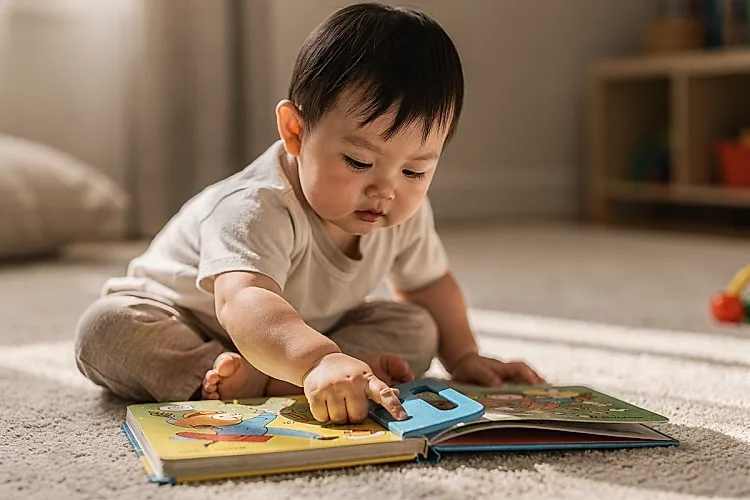
Push-pull-slide books — the mechanical ones with tabs and sliders — teach cause and effect. Push the tab, the digger moves. Pull the slider, the train rolls. Your toddler is learning that their actions have consequences, and that they can make things happen in the world. These are the busy books for toddlers that keep hands occupied for long stretches.
We'd call the key moment in all three types the reveal moment: the instant a toddler lifts a flap, pulls a tab, or touches a new texture and discovers what happens. The loop (anticipation, action, discovery, reaction) is the fundamental learning cycle these books deliver. It's why your toddler lifts the same flap thirty times. They're confirming what they already know.
7 Interactive Books for Toddlers Worth the Shelf Space
Each pick represents a different way a toddler interacts with a book. Together, they cover the full range of what interactive toddler books can do.
That's Not My Puppy... by Fiona Watt (Usborne "That's Not My..." series)
The touch-and-feel gold standard. Each page has a different texture (rough paws, silky ears, fuzzy tail), and the repetitive structure ("That's not my puppy... its nose is too bumpy") gives your toddler a refrain to anticipate and eventually complete. The Usborne "That's Not My..." series has sold over 20 million copies worldwide, and the reason is simple: the format is perfectly calibrated for toddler brains. Start with any animal your child loves. Find it on Bookshop.org
Dear Zoo by Rod Campbell
The lift-the-flap classic (wait, this is already in our best books for 2-year-olds list for good reason). Each page hides a different animal behind a flap, and the reveal moment is the entire engine: "I wrote to the zoo to send me a pet. They sent me a..." Lift. "Lion! He was too fierce." The simplicity is the genius. Every flap teaches prediction, and the resolution ("He was perfect!") teaches narrative satisfaction. Find it on Bookshop.org
Bizzy Bear: Let's Go and Play! by Nosy Crow, illustrated by Benji Davies
The push-pull-slide mechanism at its best. Chunky tabs and sliders let your toddler move Bizzy Bear through a playground: push the swing, spin the merry-go-round, slide down the slide. The mechanical satisfaction is real: your child's finger makes things happen on the page. The whole series (construction, farm, train, fire rescue) follows the same format, which means once your toddler masters one, they can "operate" them all. Find it on Bookshop.org
Mix It Up! by Hervé Tullet
The imagination-driven interactive book. There are no flaps, no textures, no mechanisms — just a lone gray dot and instructions: tap it, rub it, tilt the page. Turn the page. Colors appear, mix, and transform. Your toddler believes they made the colors change. The magic is entirely in the participation. Tullet's genius is making the child feel like the page responds to them, even though it's just printed paper. A perfect bridge between physical board books and imaginative reading. Find it on Bookshop.org
If story time is starting to work with interactive books, the next step is adding a reading routine. We built a set of illustrated stories, one in your inbox each evening for a week, to pair with the hands-on books that got your toddler engaged.
Let us handle bedtime for you. 7 stories. 7 nights. Free.
One illustrated story in your inbox each evening — plus a Wonder Question to spark the kind of conversation that only happens at bedtime.
No spam. One story per night for 7 nights.
Never Touch a Dinosaur! by Rosie Greening (Make Believe Ideas)
The sensory book that earns its place through sheer tactile joy. Silicone-textured patches on every page (spiky, bumpy, squishy, scaly) make this book impossible for a toddler to walk past without touching. The "never touch" premise is the joke (of course they'll touch it), and the rhyming text is short enough that even restless toddlers stay for the whole thing. The series covers sharks, spiders, dragons, and unicorns, so there's a version for every toddler's current obsession. Find it on Bookshop.org
Open the Barn Door by Christopher Santoro
The oversized lift-the-flap book that makes the reveal moment physical. Full-page flaps open to reveal animals that are comically larger than expected — a pig takes up the entire spread. Toddlers who have outgrown small-flap books find the scale of these reveals genuinely exciting. The question-and-answer format ("Who's hiding behind the barn door?") is simple enough for 12-month-olds and engaging enough for 3-year-olds. Find it on Bookshop.org
My First Busy Book by Eric Carle
The underdog pick for parents who want one book that covers everything. Touch-and-feel textures, lift-the-flaps, and a mirror — all in a single chunky board book wrapped in Carle's signature collage illustrations. It's not the longest or the flashiest, but it's the one your toddler will reach for first because every spread has a different mechanism to explore. Think of it as a sampler: if your child gravitates toward the flaps, buy more lift-the-flap books. If they love the textures, go deep on sensory books for toddlers. This one tells you what they want. Find it at Simon & Schuster
How to Use Interactive Books With a Toddler Who Won't Sit Still
Here's the reframe most parents need: your toddler doesn't need to sit still to benefit from a book. Stillness is an adult metric for engagement. A toddler who is flipping, lifting, touching, and squirming is engaged — their body is processing the book alongside their brain.

Three things that help:
Let them skip. Your toddler may only want the flaps. Not the story, not the pictures — just the flaps. That's fine. Every flap-lift is a prediction, a motor task, and a reveal. The story will come later. Right now, the mechanism is enough.
Name what they're doing. When they touch the bumpy patch, say "bumpy." When they pull the slider, say "pull." When the animal appears behind the flap, say its name. You're building vocabulary through action, the same principle that makes interactive reading at age 2 so powerful.
Lean into the repetition. Your toddler will open the same flap thirty times. Each repetition is confirmation. Each repetition strengthens the prediction-action-reveal loop. The twentieth lift isn't less valuable than the first. It might be more.
And if you're wondering whether interactive books are just toys disguised as books — they're not. The reveal moment delivers the same dopamine loop that makes tablet apps addictive, but through physical interaction with a real object. No screen, no battery, no algorithmic attention manipulation. Just a flap, a finger, and a child who is learning that books respond to them.
Frequently Asked Questions
The hands that tore a page out of a picture book last Tuesday are the same hands that carefully, deliberately lifted every flap this morning. Those hands haven't changed. What changed is the book gave them a job worth doing.
The toddler who carries that lift-the-flap book to the car, to the store, to bed, who opens it in the grocery line and lifts the same flap for the hundredth time while you load produce onto the belt — that's a child who has discovered that books respond when you touch them.
Every flap they lift is a question. And the book always answers.