Personalized Bedtime Stories: What They Are, What Works, and What's Worth It
Personalized bedtime stories put your child in the story. Here's how they work, when they're worth it, and what to look for in a book or app.

Minari Editor
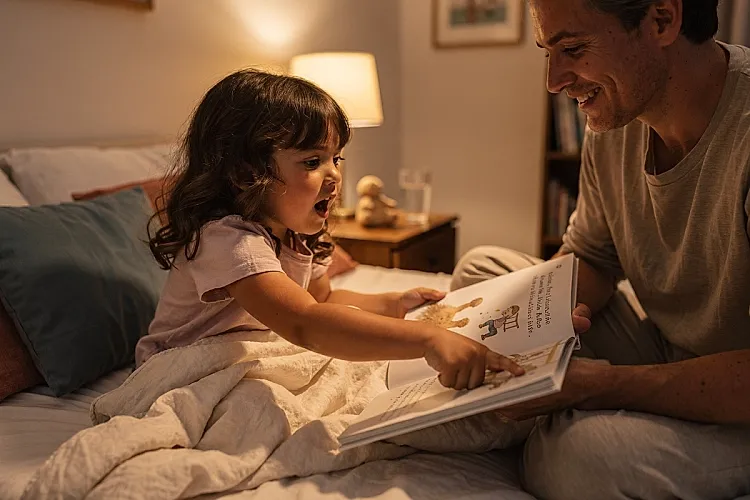
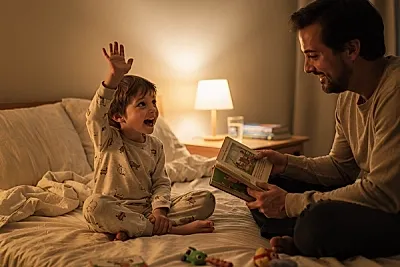
The first time your child hears their own name in a bedtime story, something changes. They sit up. They point at the page (or the screen). "That's me," they say. And from that moment, the story isn't something you're reading to them. It's something that belongs to them.
That reaction is real. It's called the name moment, and it's the reason personalized bedtime stories exist. But not all personalized stories deliver it equally. Some put a child's name on a page and call it done. Others build a world around your child — their appearance, their interests, their fears — and create a story that couldn't belong to anyone else.
The difference matters more than you think.
What Are Personalized Bedtime Stories?
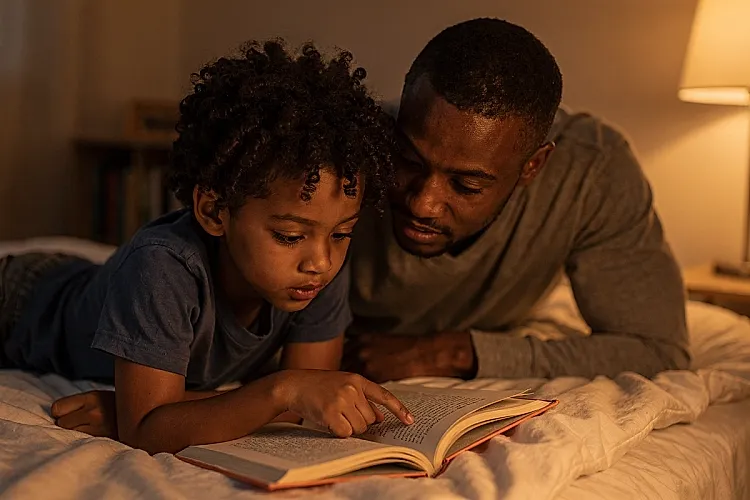
Personalized bedtime stories are exactly what they sound like: stories that include your child's name, and sometimes their appearance, interests, or life details, woven into the narrative. They come in two very different formats.
Physical personalized books — companies like Wonderbly, NAMEE, and Hooray Heroes print hardcover picture books with your child's name and a custom character illustration. You order once, it arrives in the mail, and it sits on the shelf like any other book. These are popular as gifts. The personalization is typically shallow: the child's name appears in the text and the character vaguely resembles them. The story itself is the same for every child; only the name and character image change.
AI-generated story apps — a newer category. Apps use artificial intelligence to generate a fresh story every night, tailored to your child's age, interests, and even their current emotional state. Personalized bedtime stories for toddlers might feature simple rhythms and familiar objects; stories for a 5-year-old might include adventure plots with characters who share the child's actual interests. The depth of personalization can go much further than a printed book, but the quality varies widely between apps.
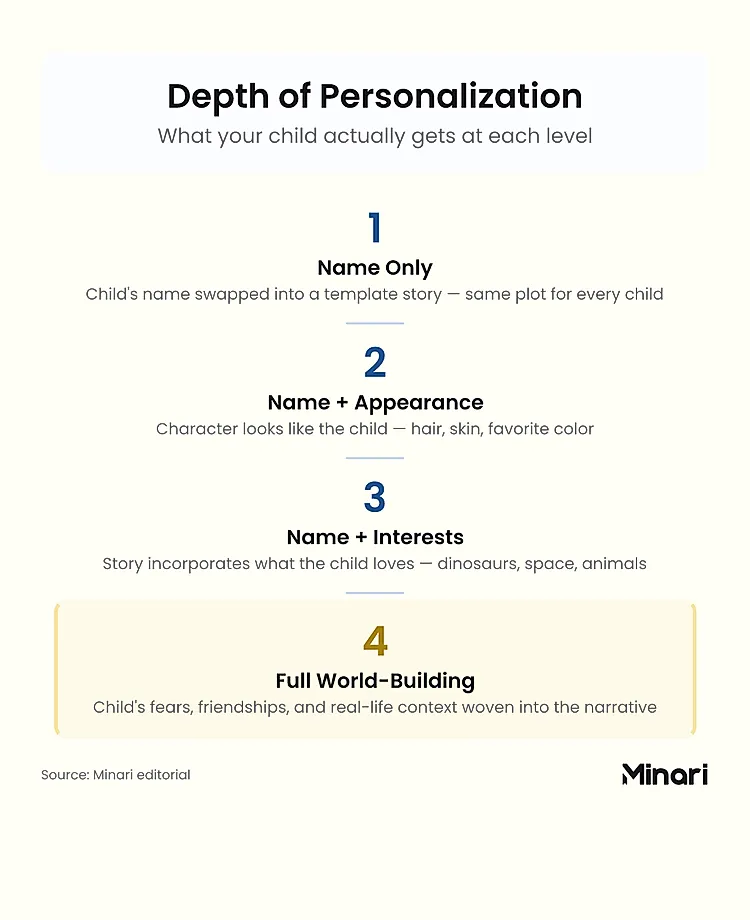
We call this range depth of personalization: a spectrum from shallow (name swapped into a template) to deep (the child's world, their friends, their fears, their favorite things, built into the story's DNA). Where a product sits on this spectrum determines whether the name moment is a one-time novelty or something that compounds every night.
Neither format replaces the bedtime stack, the rotation of real books that anchor your child's reading routine. Personalized stories are one tool in the stack, not a replacement for it.
Physical Books vs AI Story Apps: How to Choose
| Physical Personalized Books | AI Story Apps | |
|---|---|---|
| Personalization depth | Shallow: name + character image | Deep: name, interests, age, emotional needs |
| Cost | $25-50 one-time | $5-15/month subscription |
| Story variety | One story per book | New story every night |
| Format | Hardcover, printed | Phone/tablet screen |
| Best for | Gifts, keepsakes, special occasions | Nightly bedtime routine |
| Illustration quality | Professional, consistent | Varies (some app-quality, some stock) |
| Screen time | None | Yes (consider e-ink or print options) |
Choose a physical book when: You're buying a gift. The child loves seeing their name in print. You want something that lives on the shelf as a keepsake. You want zero screen time.
Choose an app when: You want a new story every night without buying a new book. You want deep personalization that adapts to your child's age and interests. You want stories that address specific emotional needs: calming stories for anxiety, brave stories for fear, stories that help kids process feelings.
If you want to try bedtime stories matched to how your child listens before committing to a subscription, we put together a week of illustrated stories delivered to your inbox, one each evening.
Let us handle bedtime for you. 7 stories. 7 nights. Free.
One illustrated story in your inbox each evening — plus a Wonder Question to spark the kind of conversation that only happens at bedtime.
No spam. One story per night for 7 nights.
What to Look for in a Personalized Story App
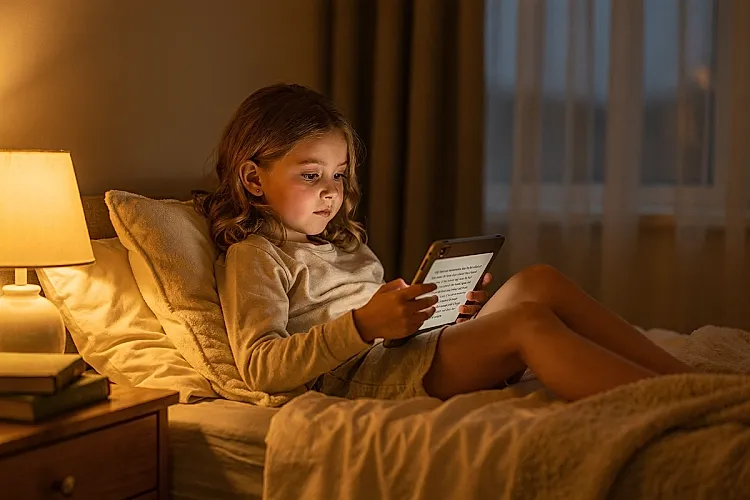
Not all custom bedtime stories for kids are created equal. Here's what separates a good app from a gimmick:
Age-appropriate language. A personalized story for a 3-year-old should read like a real picture book: rhythmic, simple, with repetition. Not like a generic text with a child's name dropped in. The best apps adjust vocabulary, sentence length, and narrative complexity to match your child's developmental stage.
Illustration quality. This is where most apps fail. If the illustrations look like clipart or stock photos, the child won't engage. Look for apps that produce artwork that feels like a real children's book: warm, textured, character-driven. The illustration should be as personalized as the text.
Story variety. Can the app generate genuinely different stories, or is it producing variations of the same template? A good app should be able to create adventure stories, calming stories, funny stories, and emotional stories, all tailored to the same child. If every night's story feels the same, the name moment wears off.
Content safety. AI-generated content needs guardrails. Look for apps that explicitly state their content moderation approach. Age-appropriate means no scary content, no inappropriate themes, no uncanny-valley illustrations. The best apps give parents preview controls.
Bedtime-specific design. A personalized story meant for bedtime should wind down, not ramp up. Look for calming pacing, gentle endings, and sleep-signal structure. The story should function as part of the story window, not work against it.
Minari builds personalized bedtime stories with all five of these principles. Each story matches your child's age and interests, uses original illustrated artwork, and is designed specifically for the bedtime window: calming, age-appropriate, and built to be the last story before sleep.
Do Personalized Stories Actually Help at Bedtime?
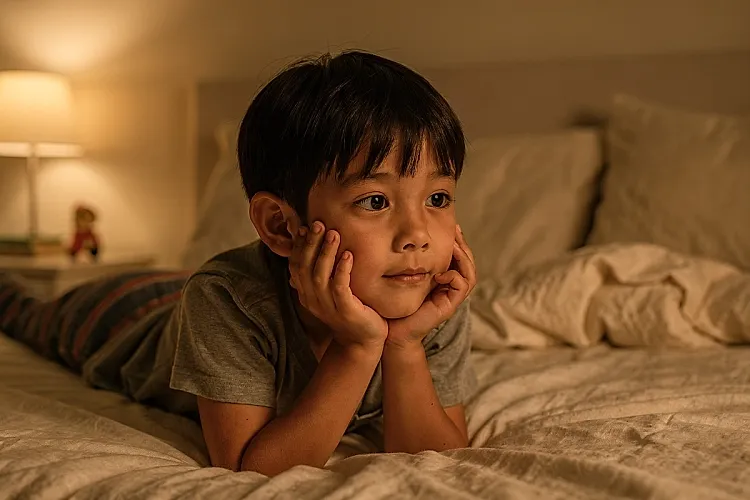
The name moment isn't just cute — it activates a cognitive mechanism called self-referential processing. When children hear their own name in a narrative, they process the content more deeply. A 2014 study in *Child Development* by Cunningham et al. found that children ages 4-6 showed significantly enhanced recognition and source memory when content was linked to themselves, a well-replicated phenomenon known as the self-reference effect.
This means a personalized bedtime story is also more effective at the things bedtime stories are supposed to do: build vocabulary, process the day's emotions, and signal that sleep is coming.
When personalization helps most:
- Bedtime-resistant kids — a child who resists generic stories will often lean in when they hear their name. The ownership factor changes the dynamic from "parent reading to child" to "child experiencing their own story."
- New routines — families building a bedtime reading habit for the first time. Personalized stories give the routine a hook: "your story is waiting."
- Transitions — a new sibling, a new school, moving to a new home. Personalized stories can address the specific transition the child is going through, which is something a generic book can't do.
When personalization doesn't matter:
- If your child already has a strong bedtime routine with books they love, personalization is a nice-to-have, not a need.
- If the child is under 18 months. They respond to your voice and rhythm, not to seeing their name.
- If the app produces low-quality content. A bad personalized story is worse than a good generic one.
Personalized bedtime stories for toddlers work best between ages 2-5, when children are old enough to recognize their name in context but young enough to be genuinely delighted by it. After age 6-7, the name moment matters less, and narrative quality takes over as the primary engagement driver. At that point, what your child needs from a story is strong plot and character loyalty, not just hearing their name.
Frequently Asked Questions
Tonight, when you read a bedtime story and your child says "that's me," whether it's a name in a hardcover book or a character on a screen who loves the same things they do, you'll see the shift. The story stops being something you chose for them. It becomes something they own.
That's the name moment doing its work.