Books About Emotions for Preschoolers (Matched to the Feeling)

Minari Editor
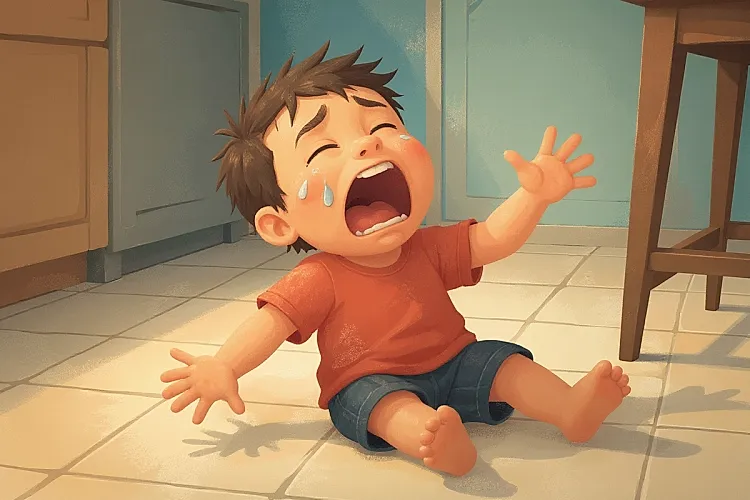
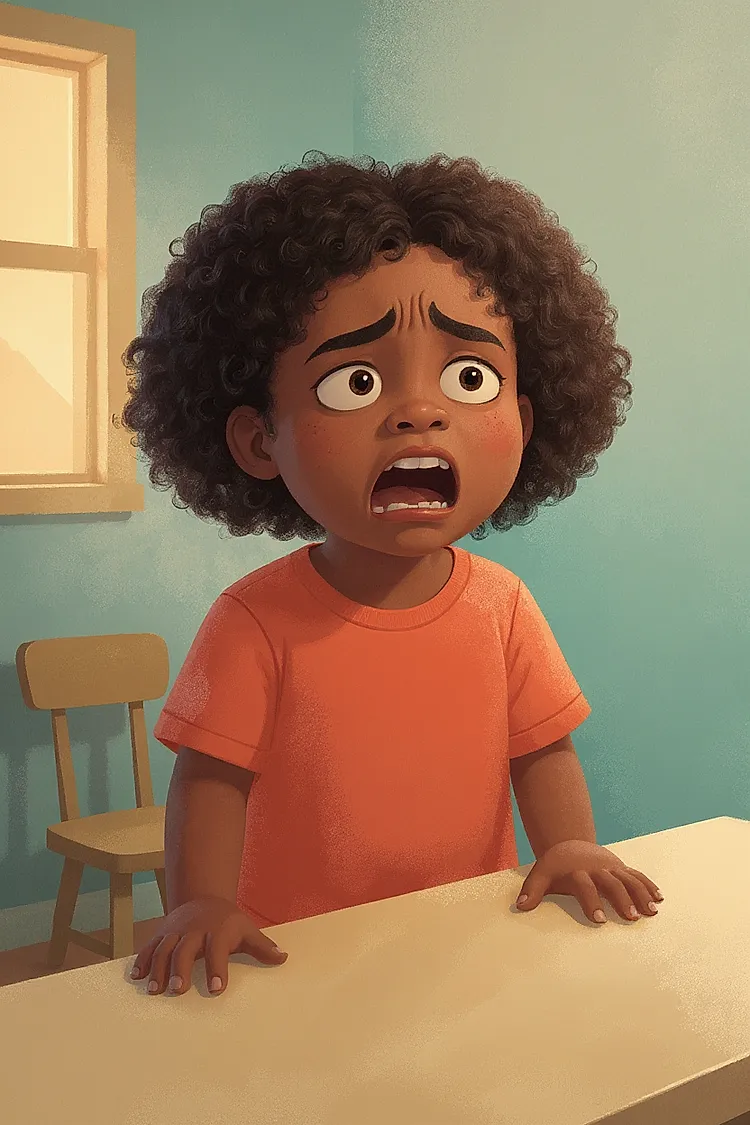
The cup is the wrong color. That is the entire catastrophe — green, when it was supposed to be blue — and your three-year-old is face-down on the kitchen floor, howling into the tile, too far gone to hear you. You crouch down and ask what's wrong. They can't tell you. They don't have the word yet for the enormous thing crashing through them.
This is the exact moment the best books about emotions for preschoolers are built for. At three, big feelings are a vocabulary problem first: the feeling always arrives before the word for it does.
Hand a child the words for what they feel, on a calm afternoon when no one is melting down, and you give them something to reach for when the storm hits. The strongest picks below — The Way I Feel, In My Heart, The Feelings Book, My Many Colored Days, Sometimes I'm Bombaloo, and Big Feelings — each help a preschooler name a different slice of the emotional world.
Why naming a feeling calms a preschooler
There's a reason "use your words" is the oldest advice in the preschool playbook, and a reason it so rarely works in the moment: a three-year-old often doesn't have the words yet. Brain researchers call the fix affect labeling — UCLA psychologist Matthew Lieberman's fMRI research found that simply putting a feeling into words measurably reduces amygdala activity, lowering the emotion's intensity. Naming the storm turns the volume down. But a child can only name what they have a word for, which is where preschool books about feelings come in.
Think of it as the feelings word bank. Every time you read an emotion book on an ordinary day, your child banks a few more words: frustrated, nervous, disappointed, proud. Then, on the hard day, those words are available to spend. The goal is the naming reflex — the moment your child reaches for "I'm so mad!" instead of throwing the cup. That swap, from action to word, is the whole skill, and it is built slowly, in calm moments, long before it's needed.
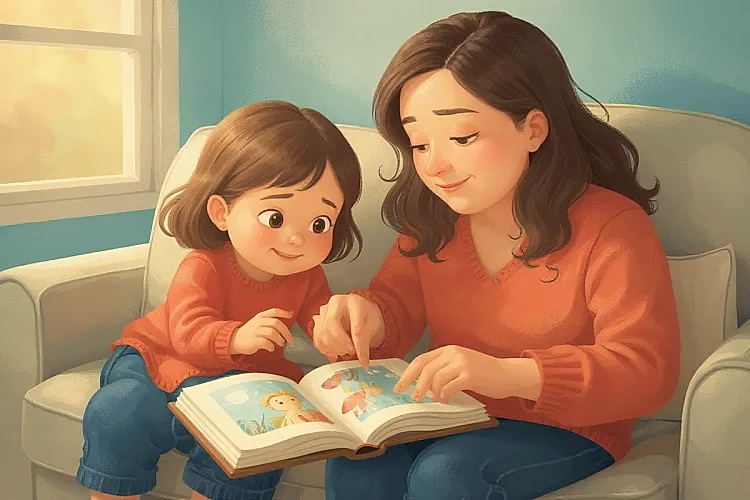
This is also why a book outperforms a lecture. A story lets a child meet anger or sadness at a safe distance, in a character, and try the feeling on without being in its grip. Preschool books emotions experts recommend share that quality: they show the feeling from the outside, name it plainly, and let the child connect it to their own insides in their own time.
The best books about emotions for preschoolers
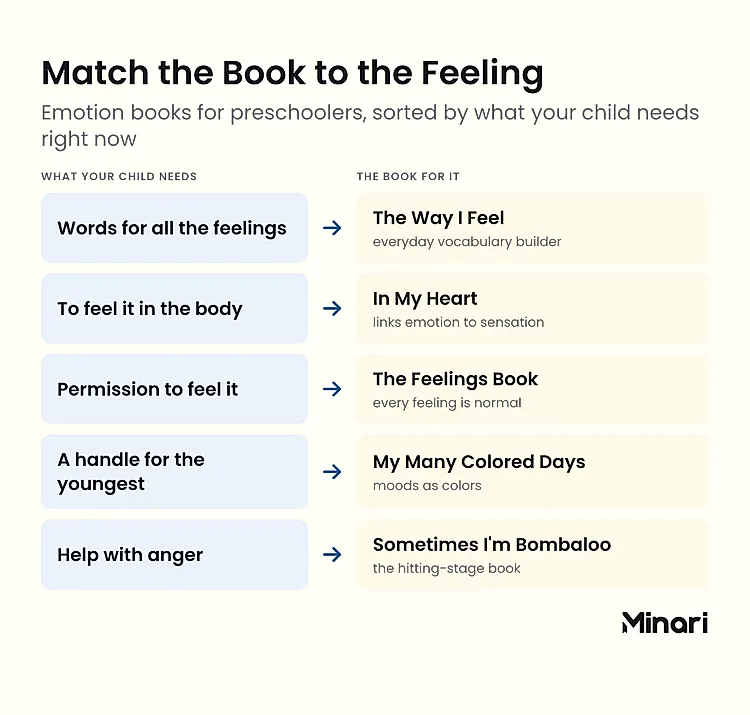
These six books about feelings for preschoolers are the ones to keep on the shelf for the 3-5 stage, organized by the specific job each one does. You don't need all six — pick the one that matches what your child is wrestling with right now.
"All the feelings, named" → *[The Way I Feel](https://bookshop.org/p/books/the-way-i-feel-janan-cain/11769343)* by Janan Cain. A rhyming tour through the whole emotional range, from silly to scared to jealous, with one bold feeling per spread. It's the everyday vocabulary builder, and the best first feelings book for a child who's just starting to need the words.
"Where feelings live in the body" → *[In My Heart: A Book of Feelings](https://bookshop.org/p/books/in-my-heart-a-book-of-feelings-jo-witek/58dcc1a092098e86?ean=9781419713101)* by Jo Witek. A die-cut heart shrinks and swells through the pages as it connects each emotion to a physical sensation — happiness that makes you light, anger that bubbles hot. For a child who feels everything in their body before their brain catches up, this is the bridge.
"It's okay to feel that" → *[The Feelings Book](https://bookshop.org/books/the-feelings-book/9780316012492)* by Todd Parr. Bold, bright, and gloriously simple, Parr's book is permission more than instruction: every feeling is normal, even the messy ones. It's the feelings book preschool teachers reach for when a child seems ashamed of being angry or sad.
"Feelings have colors" → *[My Many Colored Days](https://bookshop.org/p/books/my-many-colored-days-dr-seuss/fff1c87ed0fd6de7)* by Dr. Seuss. Seuss maps moods onto colors (a blue day for sadness, a bright pink day for happiness, a mad black one), which gives even the youngest preschooler a concrete handle on something invisible. A gentle entry point for two- and three-year-olds.
"The anger one" → *[Sometimes I'm Bombaloo](https://bookshop.org/p/books/sometimes-i-m-bombaloo-rachel-vail/8edb9b52d6fa9a07)* by Rachel Vail. When Katie Honors gets really, really angry, she loses her words entirely and becomes "Bombaloo." This is the book for the hitting-and-kicking stage specifically, because it names the wordless rage a preschooler actually feels and shows the way back to calm.
"Big feelings out in the world" → *[Big Feelings](https://bookshop.org/books/big-feelings-9780525579748/9780525579748)* by Alexandra Penfold. A backyard project goes sideways, and a whole crew of kids cycles through frustration, blame, and the urge to quit before they cool off and rebuild it together. It's the pick for the social meltdowns: the ones that erupt with other kids over sharing, fairness, and the thing that didn't go your way.
For more read-aloud favorites across this age beyond the feelings theme, our list of the best books for 4 year olds covers the wider shelf.
The single best time to build that word bank is a calm, predictable moment you already have: the wind-down before sleep. Our free seven-night story collection sends one illustrated bedtime story to your inbox each evening — a steady, low-stakes slot to fold a feelings book into, so the vocabulary goes in when your child is settled rather than stormy.
Let us handle bedtime for you. 7 stories. 7 nights. Free.
One illustrated story in your inbox each evening — plus a Wonder Question to spark the kind of conversation that only happens at bedtime.
No spam. One story per night for 7 nights.
How to use feelings books so they actually work
Owning the right book is half of it. Using it well is the other half, and the rules are simple. Read on a calm day, not mid-meltdown. A child in the grip of a big feeling can't take in a story, so the book's job is done in advance, banking the words for later. Then, when the storm comes, you supply the word you both already know: "You're feeling frustrated. I get it."
A few more things make it stick. Name your own feelings out loud in everyday life ("I'm disappointed the rain cancelled the park, I need a minute"). This is the part most lists skip: a child won't risk saying "I'm angry" until they've watched a grown-up say it calmly and stay completely loved on the other side. The books supply the words; you show they're safe to use. Revisit the same titles often, because repetition is what banks the vocabulary, and resist turning the story into a lesson. Let the book do the teaching while you just read. If you want the bedtime-specific version of all this, our guide to bedtime stories about feelings covers how the same skill works in that quieter hour.

Then, some ordinary afternoon, you'll hand over the wrong-colored cup and watch your child's face begin to crumple. And instead of dropping to the floor, they'll look up and tell you, "I'm so FRUSTRATED." It won't fix the cup. But it is the whole skill arriving right on time: the feelings word bank, spent at the exact moment it was built for.
What about kindergarteners and older?
Everything here works straight through kindergarten — these are solid books about feelings for kindergarten classrooms and homes too. By five and six, the vocabulary deepens: kids move from naming a feeling to understanding what caused it and noticing it in other people, which is where empathy begins. The same books still earn their place; you'll just find your conversations about them growing more complex. (Parents searching specifically for books about feelings for 5 year olds can start with this exact set and simply talk about the why behind each feeling.)