Books About Feelings for Toddlers (Matched to the Feeling on the Floor)

Minari Editor
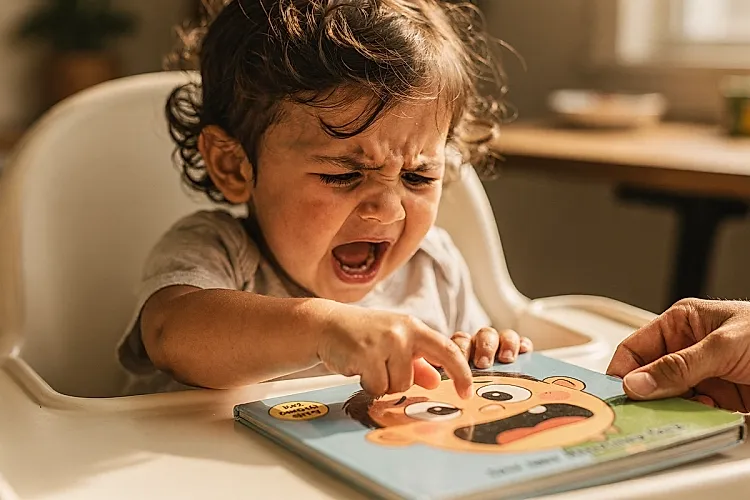
Your not-quite-two-year-old is mid-arch in the high chair, back rigid, face an open wound of a wail, and there are no words coming because there are barely any words yet. Half-desperate, you reach for the board book wedged under the tray, the one with the big crying face on the cover. You tap it. "He feels sad too." And for one second, the screaming catches. She looks. A fat finger lands on the page.
That second is the whole reason books about feelings for toddlers exist. At two and three, a child reads emotion through faces long before words — they can match a feeling on a page to the storm inside their own body well before they can say "sad" or "mad" out loud. So the best toddler feelings books are short, sturdy board books with one big, unmistakable feeling-face per spread, and you choose them by matching the book to the feeling. The six picks below, from Baby Happy Baby Sad to Calm-Down Time, each give a toddler one clear face to find.
Why books reach a toddler when words can't
Try reasoning with a screaming two-year-old and you learn fast that the usual tools are missing. There is no "use your words" yet, because the words mostly aren't there. A tantrum at two isn't bad behavior, it's a feeling with no exit: a brain that feels everything at full volume and cannot yet steer. What a toddler can do, surprisingly early, is read a face. Long before they can name an emotion, they can recognize one on someone else's face and feel the echo of it in themselves.
That recognition is the face-match — the moment a child connects a big feeling drawn on a page to the same feeling moving through their own body. It is the toddler version of self-awareness, and it runs entirely on pictures. A board book with a single, bold, sad face does something a lecture never can: it shows the feeling from the outside, at a safe distance, in a face a toddler can study for as long as they want. Match made on a hundred calm afternoons becomes a handhold on the hard ones.
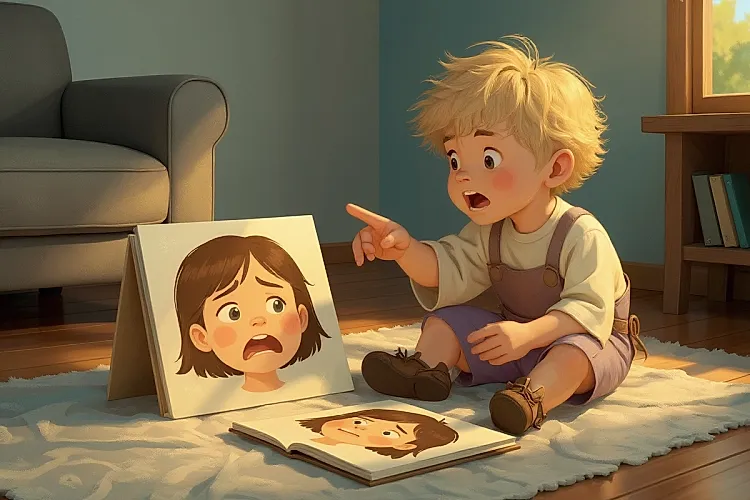
The second thing a toddler can't do alone is calm down. Self-regulation is a skill that is barely under construction at this age; a 2-3 year old simply does not yet have the brain wiring to settle a big feeling by themselves. They get there by borrowing it from you. Child development experts call this co-regulation, and it is the engine under everything in the toddler years: a child steadies by leaning on a calm adult until, years later, they can be calm on their own. I think of it as borrowed calm. Reading a feelings book together is a low-stakes rehearsal of exactly that loan. Your unhurried voice, your finger on the page, your "he feels sad too" — that is the regulator your toddler can't be for themselves yet, practiced in a quiet moment so it's familiar in a loud one.
This is also why board books, specifically, are the right tool for two and three. The text is short enough for a short attention span. The pages survive being grabbed, bent, and gummed. And the format invites the forty-times rereading that actually banks the face-match. A long, wordy picture book is built for a four- or five-year-old who can sit with a plot; a toddler needs the feeling delivered in one sturdy spread they can return to again and again.
The single best time to build the face-match is a calm, predictable moment you already have: the wind-down before sleep. Our free seven-night story collection sends one illustrated bedtime story to your inbox each evening, a steady, low-stakes slot to fold a feelings book into, so the faces go in while your toddler is settled rather than stormy.
Let us handle bedtime for you. 7 stories. 7 nights. Free.
One illustrated story in your inbox each evening — plus a Wonder Question to spark the kind of conversation that only happens at bedtime.
No spam. One story per night for 7 nights.
The best books about feelings for toddlers
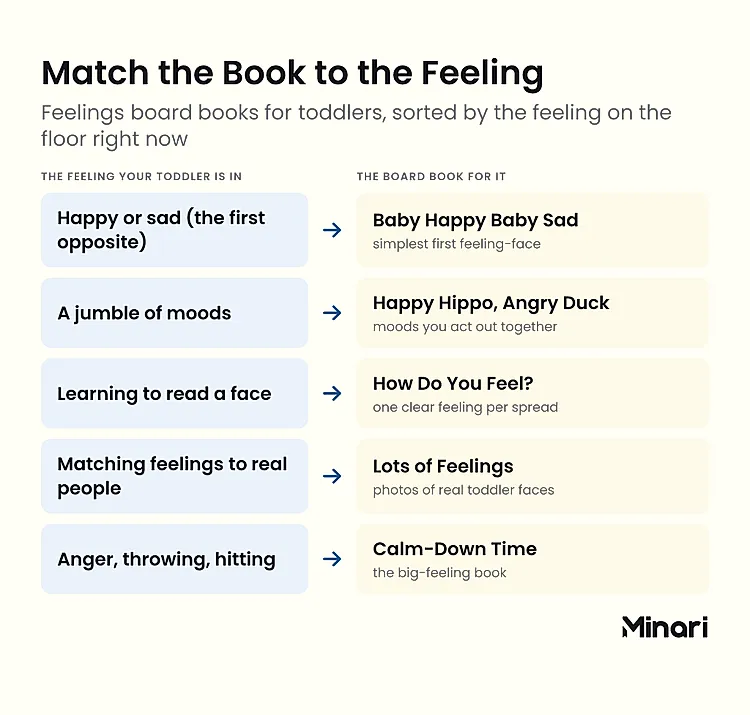
These six books about feelings for toddlers are the ones to keep within reach for the 2-3 stage, each chosen for the specific feeling-face it offers. You don't need all six. Pick the one that matches the storm you're actually in.
"The simplest first feeling" → *[Baby Happy Baby Sad](https://bookshop.org/books/baby-happy-baby-sad/9780763632458)* by Leslie Patricelli. One toddler, one balloon, happy on one page and sad on the next when it floats away. Patricelli strips emotion down to its very first opposition, happy and sad, in big flat color a one-year-old can read. It's the best place to start for the youngest twos.
"Moods you can act out" → *[Happy Hippo, Angry Duck](https://bookshop.org/books/happy-hippo-angry-duck-a-book-of-moods/9781442417311)* by Sandra Boynton. A rhyming lap-read that runs through a whole zoo of moods, happy, angry, sad, grumpy, worried, with Boynton's bouncing rhythm pulling a toddler along. Made for acting the feelings out together, scrunching your face grumpy and then going happy, which is the face-match turned into a game.
"One clear feeling per face" → *[How Do You Feel?](https://bookshop.org/books/how-do-you-feel/9780763658625)* by Anthony Browne. A small chimp wears one plain emotion per spread, bored, happy, lonely, full, and the simple text ends by turning the question to your child: and how do you feel? It's the face-match in book form, with a built-in invitation to point.
"Real faces to match" → *[Lots of Feelings](https://bookshop.org/books/lots-of-feelings/9780761323778)* by Shelley Rotner. Instead of drawings, Rotner uses photographs of real toddler and child faces mid-feeling: a true scowl, a real grin, an actual pout. For a child learning to read human faces, matching the feeling to an actual person on the page is a powerful bridge from book to the dinner table.
"Where the good feelings come from" → *[My Heart Fills With Happiness](https://bookshop.org/books/my-heart-fills-with-happiness/9781459809574)* by Monique Gray Smith. Not every feelings book has to be about the hard ones. Smith's gentle board book, illustrated by Julie Flett, names the small sources of joy, the smell of bannock baking in the oven, holding a grandmother's hand, so a toddler learns that good feelings have causes worth noticing too.
"The big one: anger" → *[Calm-Down Time](https://bookshop.org/p/books/calm-down-time-elizabeth-verdick/15722772)* by Elizabeth Verdick. Part of the Toddler Tools series, this board book walks a child through the hot, hard feeling and a few simple ways back to calm: take a break, breathe, hug something soft. It's the pick for the throwing, hitting, biting stage, and its quiet message, that a grown-up's steadiness helps you find your own, is borrowed calm in board-book form.
For the same skill a couple of years on, when the words finally arrive and your child can start saying the feeling out loud, our guide to books about emotions for preschoolers picks up the 3-5 stage.
How to use a feelings book with a toddler
Owning the right board book is half of it. Using it the toddler way is the other half, and the rules are few. Read it on calm days, not in the middle of a tantrum. A two-year-old in the grip of a big feeling can't take in a story at all, so the book does its work in advance, making the sad face familiar long before the sad moment arrives. Then, when the storm comes, the face is already known and you can name it together.
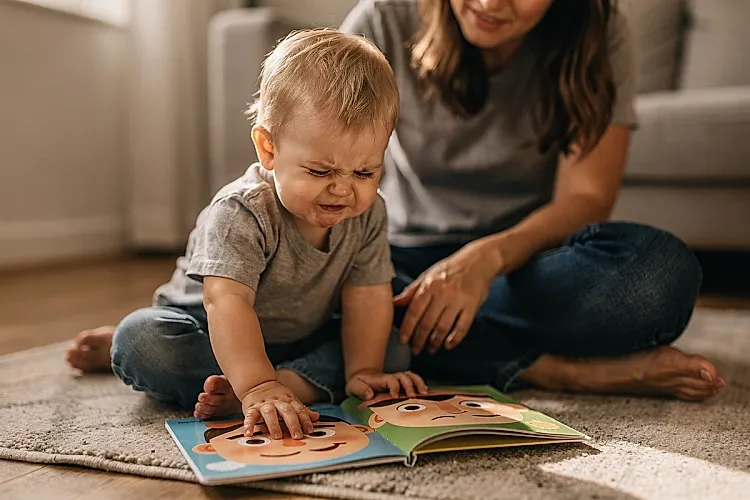
A few small habits make it stick. Point to the feeling and let your toddler point too. "He's mad. Look at his face." A jabbing finger is how a toddler talks, so meet it there. Name your own feelings out loud in ordinary life, in plain toddler-sized words: "I'm frustrated the blocks fell. I'm taking a big breath." A child this young learns the feeling is safe to have by watching you have it and stay calm. And read the same book over, and over, and over. The forty-times rereading that drives parents quietly mad is the entire method at this age; repetition is what banks the face-match. Resist the urge to quiz or turn it into a lesson. Just read it, point, and let the faces do the teaching. The calmest, most repeatable slot of all is the wind-down before sleep, and our guide to bedtime stories about feelings covers how the same work goes on in that quieter hour.
That covers the most-asked question from parents of toddlers, how do you teach a toddler about feelings? You don't teach it like a lesson. You build it in tiny, repeated, low-pressure moments, on the floor, on a lap, on a calm afternoon, one familiar face at a time.
What to do in the middle of a big feeling
The other question parents ask is the hardest one: how do you help a 2-year-old through a big feeling once it's already here? The honest answer is that the book is not the tool for that moment. Mid-storm, your toddler can't read, can't reason, and can't borrow calm from a parent who is also losing it. So you go first. Get low, get quiet, and lend the steadiness: a calm voice, a steady body, and the simple name you both already met on the page. "You're so mad. I'm right here." You are not fixing the feeling. You're being the borrowed calm until it passes, which it will.
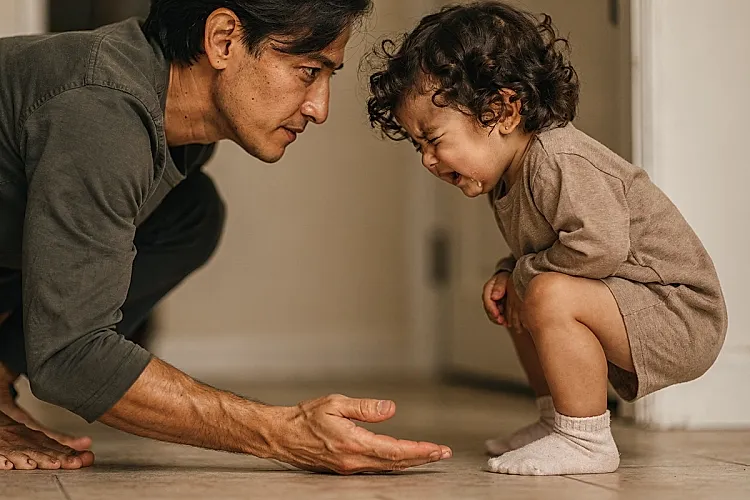
And here is the reassurance worth holding onto: these storms are not a sign that anything is wrong with your toddler, or with you. Feelings this big at two and three are exactly on time, the loud and ordinary work of a brand-new emotional brain. Every calm read on an ordinary day is a quiet handhold you're nailing into the wall, ready for the next time the floor drops out.